The end of the year is rapidly approaching and, after a quick audit, I’ve realized a substantial backlog of projects that I have been meaning to post about. With the holidays on the horizon now is as good a time as any to catch up, so here goes…..
First up – a new Vandervort Realty Logo. Jodie’s real estate brokerage is growing and has expanded into property management. Although that doesn’t necessarily warrant a new logo, I couldn’t help but add some flare to the one that I created for her in 2021. My real reason for the gussying up? I wanted to surprise her with an applique for the glass doors leading to her home office and realized the original design didn’t exactly “pop”. Although I don’t expect “Vandervort Realty” swag to be a big seller, you can order your very own hat, shirt, coffee mug on my TeePublic store.
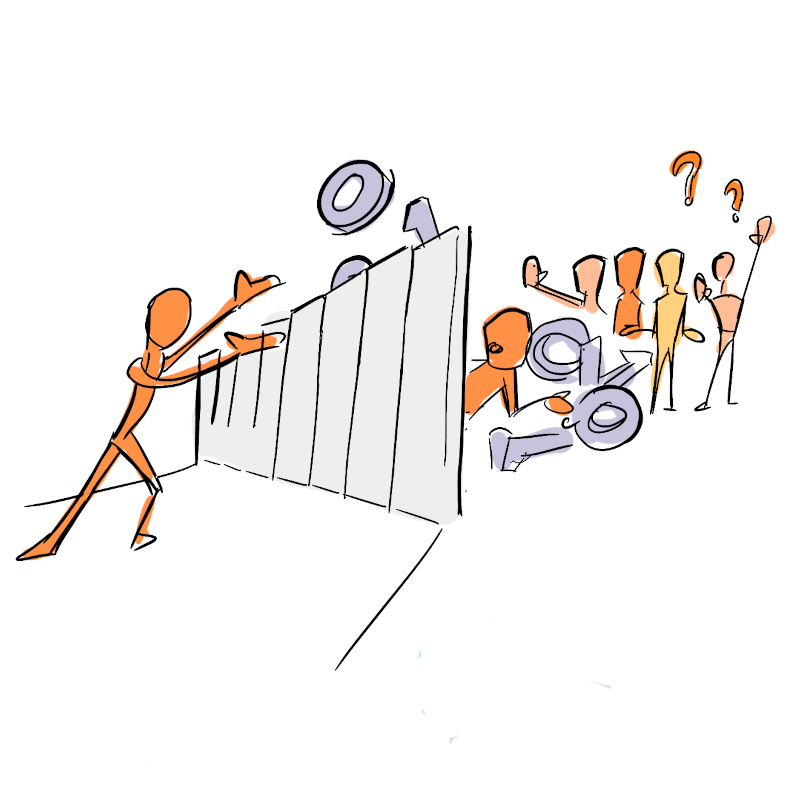
Next up – yet another comic based on my experiences in Corporate America. “Firehosing” is a term used in tech circles that is used to describe feeding someone information at such a rate that it’s impossible to digest. This particular comic has been sitting in my sketchbook for a while and it was overdue for some ink and color.
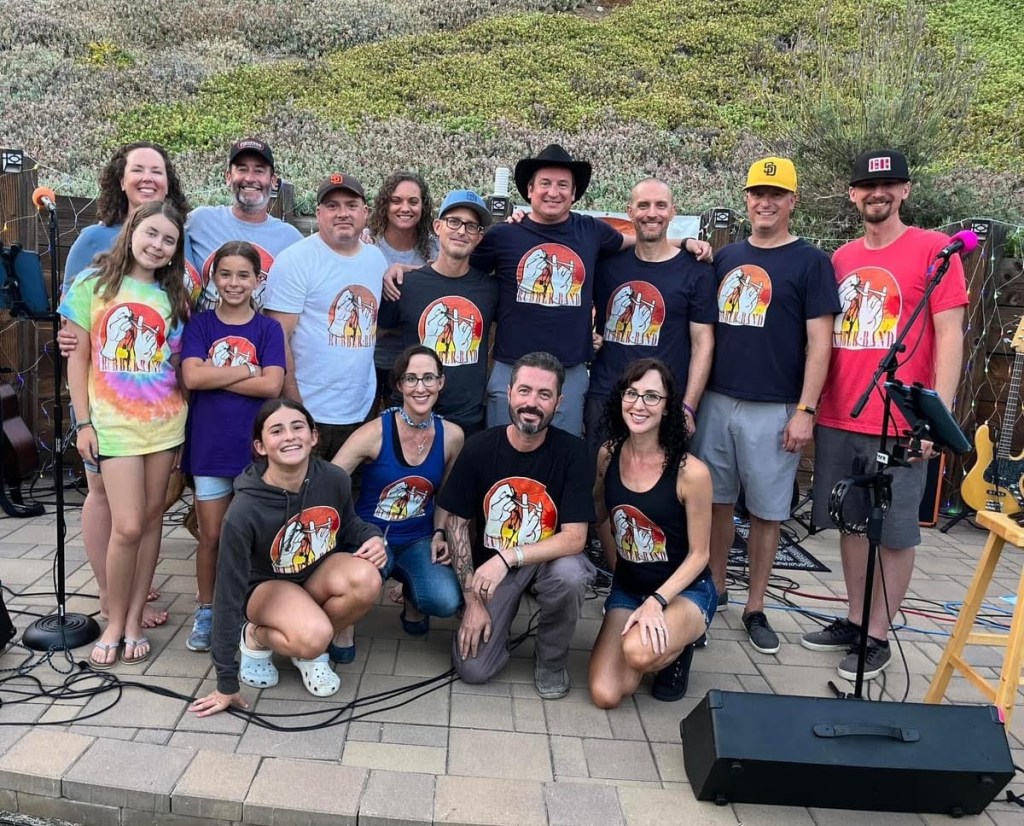
The Rubber Band and Penny, the birthday girl.“I Wanna Be Sedated” by The Ramones“I Won’t Back Down” by Tom Petty“What’s the Frequency, Kenneth?” by R.E.M.“Santa Monica” by Everclear
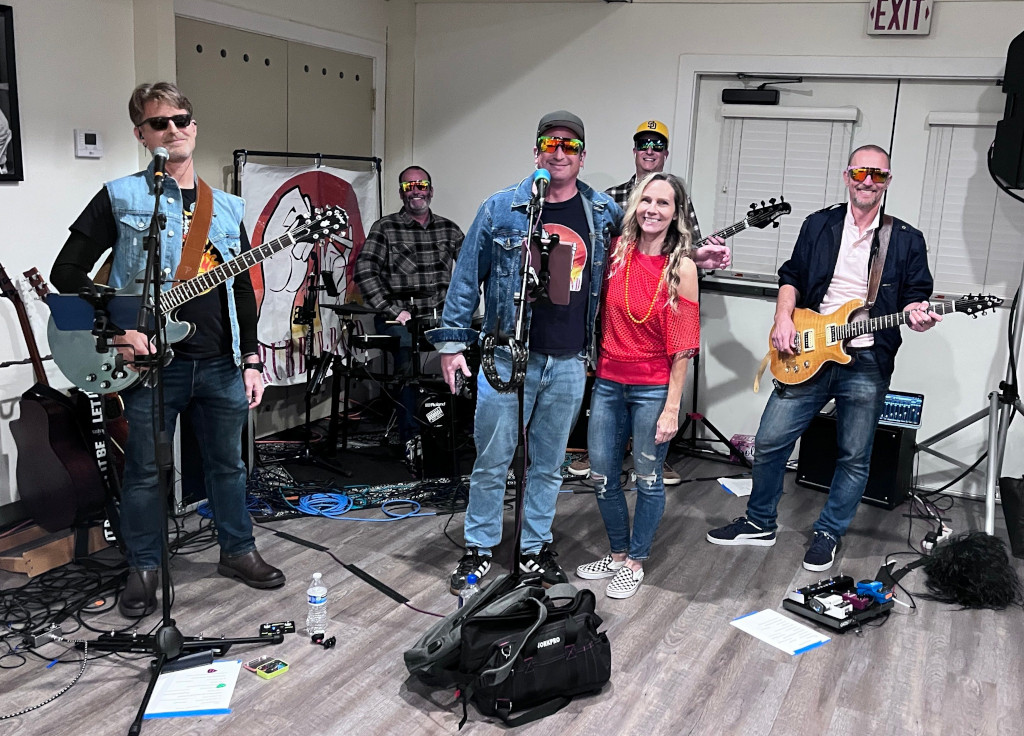
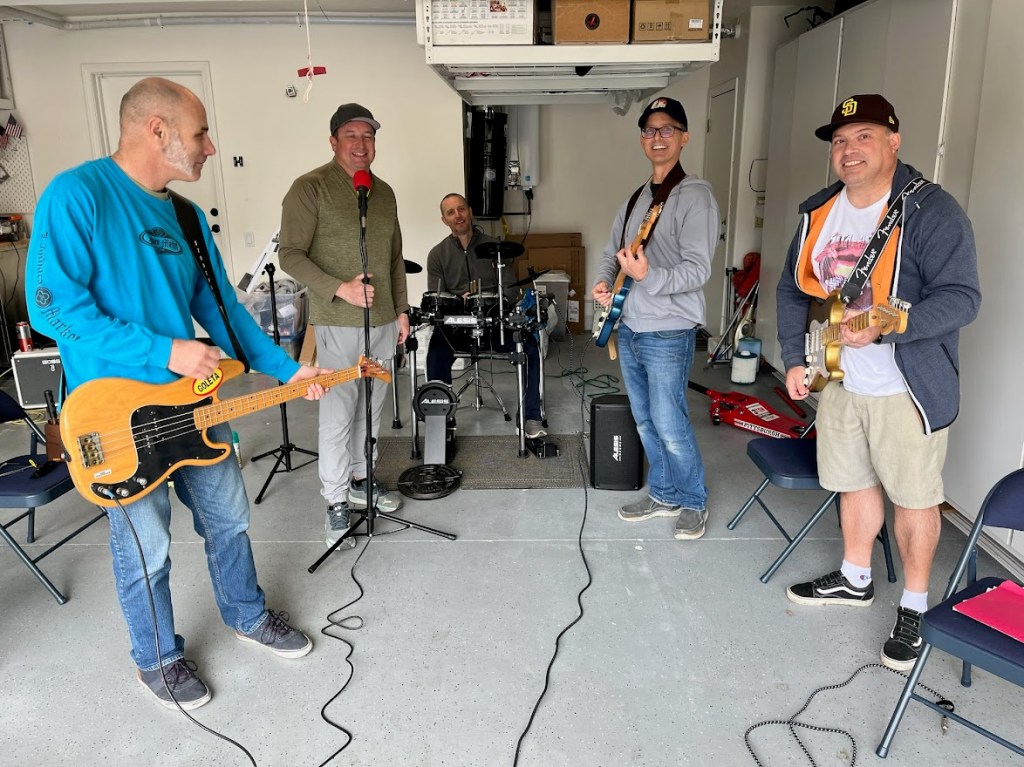
Next up – some tracks of The Rubber Band playing at my good friend, Penny Bauder’s, 50th Birthday Party at the Westwood Club. We played about twenty songs – three of which I sang lead vocals on – all of which I opted to post here. I’ve been working hard on improving my voice ( and accompanying myself on guitar), so please indulge me. On a side note, if you want to indulge me further please go buy some band swag on my TeePublic store.
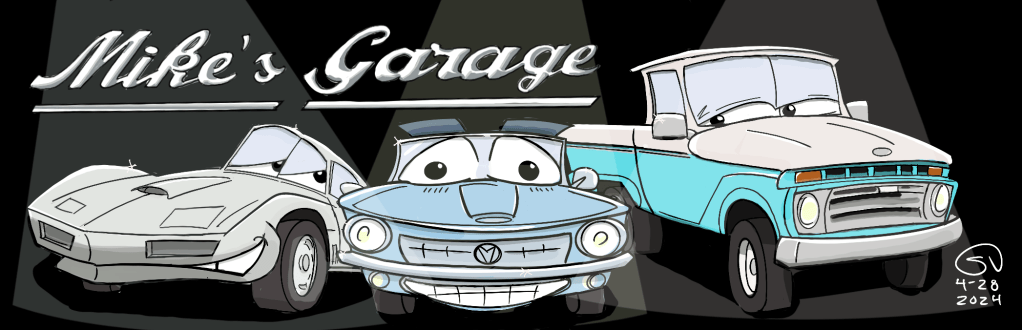
Next up – some concept artwork I created for my friend, Mike Jock, for his new car dealership, Classic Motors ( Facebook Page ) . Mike had been bouncing the idea around for a while and finally pulled the trigger earlier this year. If you’re looking for a used car, give him a call.
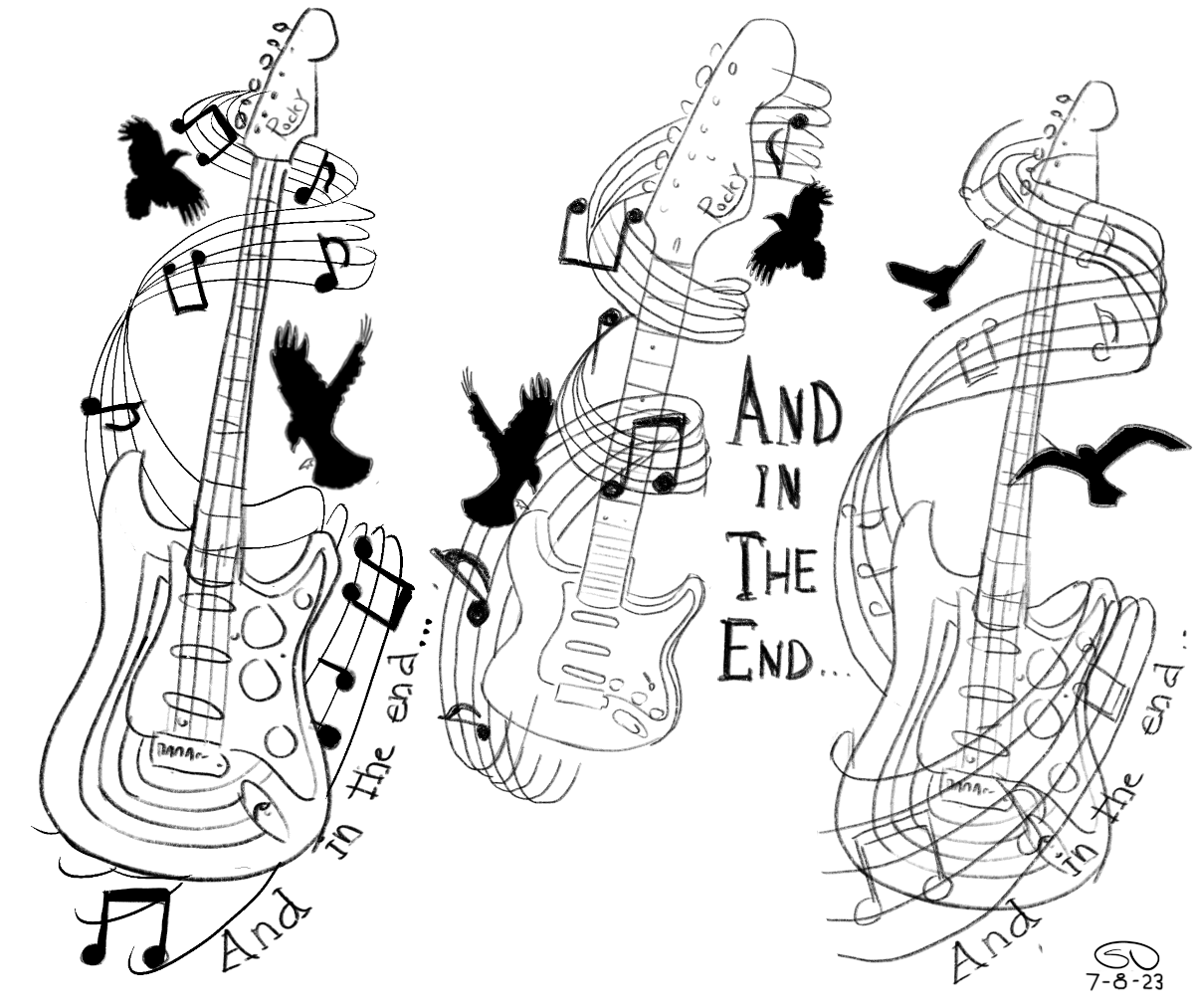
Next up from 2023 – some tattoo sketches that I created over a year ago for my band’s lead guitarist, Shawn Burgwald. He wanted something to honor his late dad, Eric, who was a huge Beatles fan. The guitar pictured is of “Rocky”, George Harrison’s eccentrically-painted Fender Stratocaster.
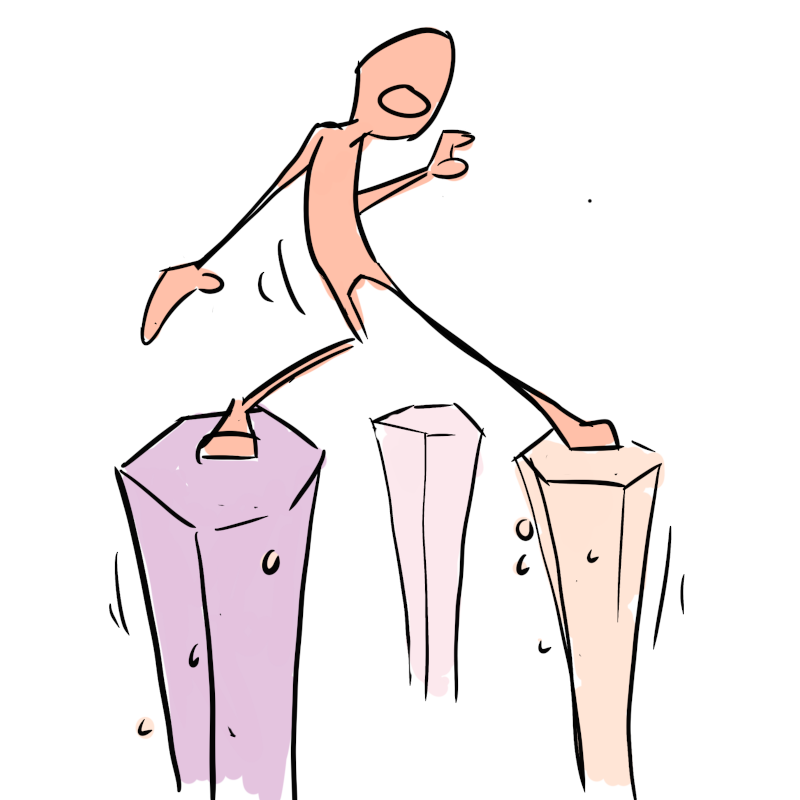
Next up from 2022 – a comic I drew after spending the better part of a month recovering from pneumonia. On the left is Asclepius, the Greek and Roman god of medicine and healing. On the right is Zeus, the king of gods. A hidden joke for those unfamiliar with Greek Mythology is that Zeus did in fact kill Asclepius after Asclepius attempted to heal mortals of wounds that would have normally been fatal. Zeus’ fear? That Asclepius would close the gap between mortals and gods.
Next up from 2021 – some concept drawings I did for a an illustrated book on engineering security practices that my college buddy, Adham Shabaan, and I were tossing around. The artwork was designed to make the material more approachable. Unfortunately, the idea failed to gain critical mass.
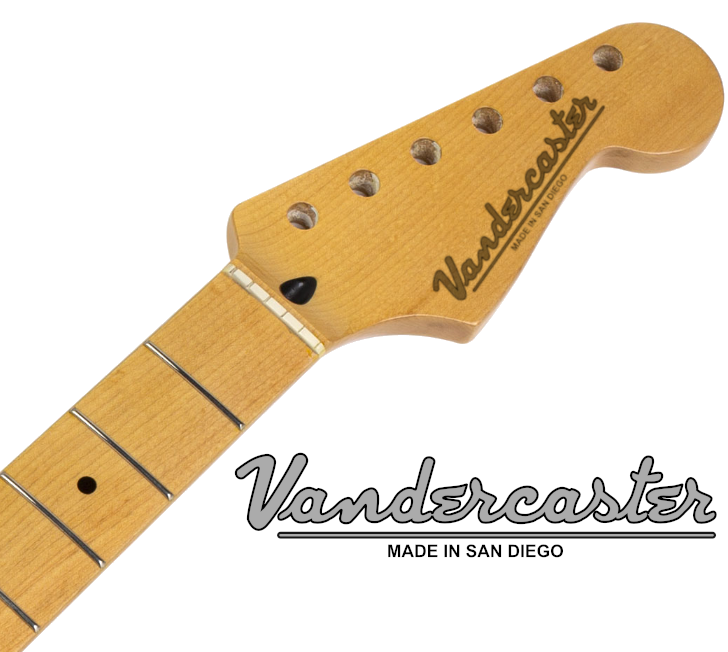
Next up from 2021 – a logo I created for the custom Stratocaster my brother, Todd Vandervort, built for me. Yes, it’s a play on words and probably wouldn’t fly past Fender’s legal department without being riddled with holes. My brother decided to use the more conventional “Fender Stratocaster” applique on the headstock, instead. As far as the guitar? It sounds great. I’m so lucky to have my own personal luthier in the family.
Phew! That’s it. I’ll try and stay on top of things moving forward.
The band has changed a little. Shawn now primarily plays electric guitar rather than drums. Colin Young has taken up the drums in his place. Mike Jock, our original bassist, has decided to pursue other things. John Hatcher has replaced him on bass, and has introduced a banjo into some of our covers. Kenn Matthews maintains his role as lead vocalist. My brother, Todd Vandervort, and I bring up the rear on our respective guitar.
Aside from playing guitar I’ve started singing a little, too, lending backup vocals for Kenn as well as the occasional song. I joke with the guys that I have exactly two octaves to play with, but I’ll leverage them to the hilt if they’ll let me. The shower is now my studio and my family, the unfortunate audience. As for guitar, I find myself mostly playing acoustic. At band practice, surrounded by amplified electric guitars, it can be like bringing a knife to a gunfight, but I manage.
As far as the future of The Rubber Band? We’re trying to get out of the garage and start playing live more. It’s tough, though. We’re all Dads with families, jobs, and responsibilities vying for our attention. It’s hard enough to find time to practice alone, let alone as a group. But, we manage. And the good news? We’re getting better, too.
Maybe someday we’ll be the best band in a four block radius.
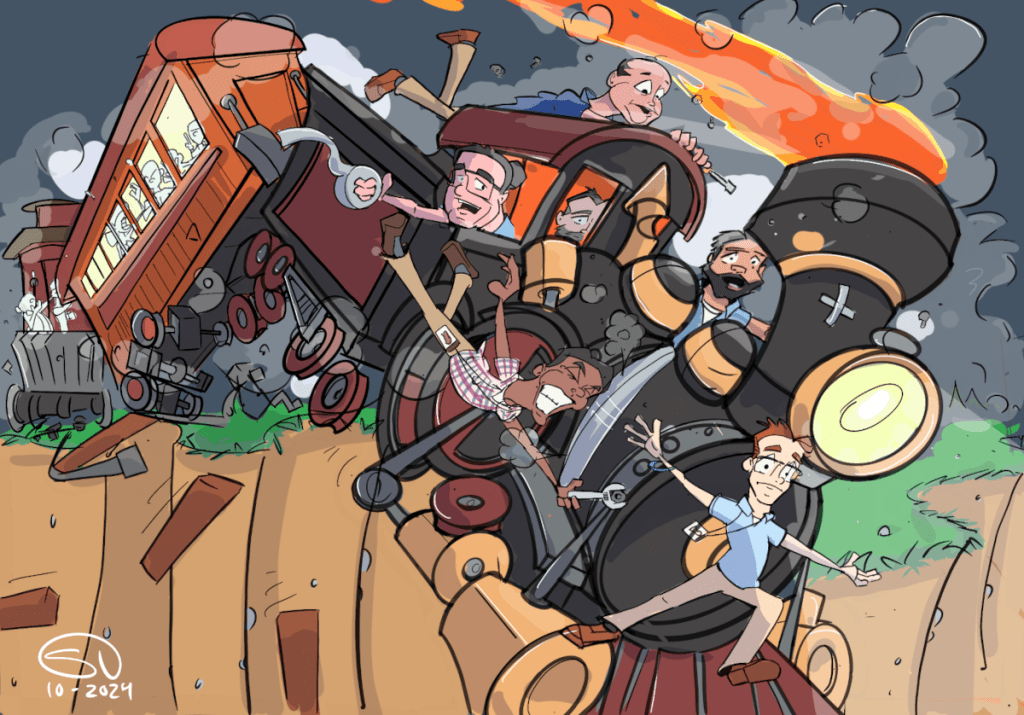
To my (old) team at UPS : Thank you for helping me keep the ol’ train on the rails for the last couple of years.
This is my station ( time to get off ) …
I resigned from my job as an Application Development Manager at UPS. While I enjoyed working with my team, I found myself increasingly at odds with my supervisor, a rigid back-to-office policy, an incredibly stale technology stack, an almost criminal lack of respect for working conditions, and an-out-of-touch CEO.
I have started interviewing, but it has been rough. I am finding myself overqualified for the software development positions that I enjoyed during the first two decades of my career. In Corporate America you are two things : a number and a salary. When either of those tips the scale you either need to adapt, or risk sliding off of the scale altogether. I’m trying to adapt, but as a software engineer ( also known as an “Individual Contributor”), I am finding myself competing with younger and/or cheaper talent than me.
That leaves management, which, at least at UPS, became an increasingly tough pill to swallow. As a manager I felt like my primary function was to find ways to manipulate people to do the greatest amount of work possible in the least amount of time against increasingly impossible deadlines. As a manager I never felt like I was helping people grow or learn. Aside from the paycheck, it was not a rewarding experience.
As I have gotten older and dealt with some pretty significant life changes, I find myself wanting to make a difference – wanting to help people. Yes, I am probably naive in the assumption that such a meaningful position exists for me, but I am not going to give up hope.
One last thing …
Interviewing can suck hard
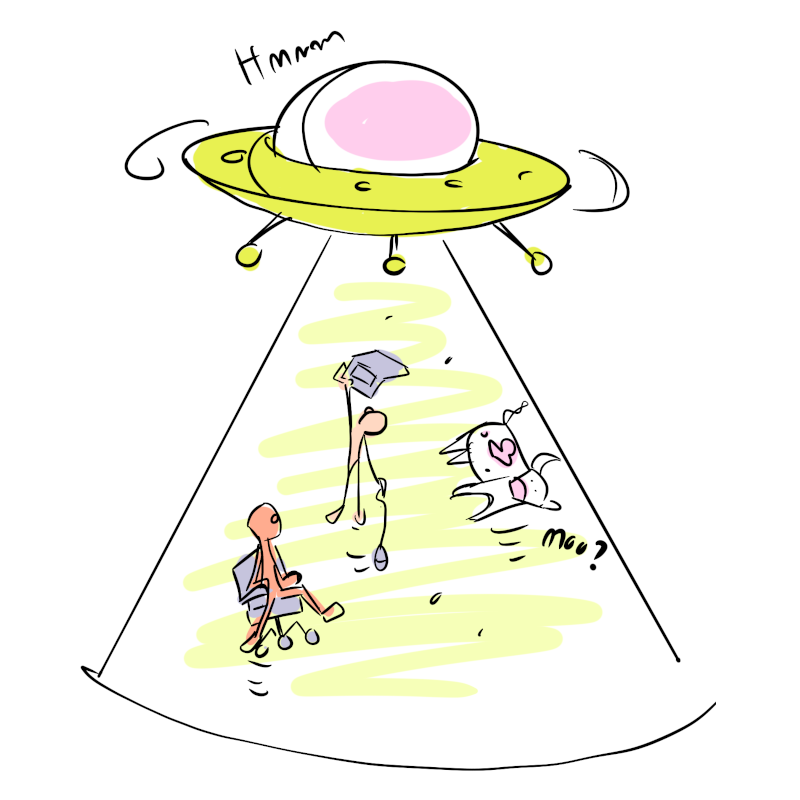
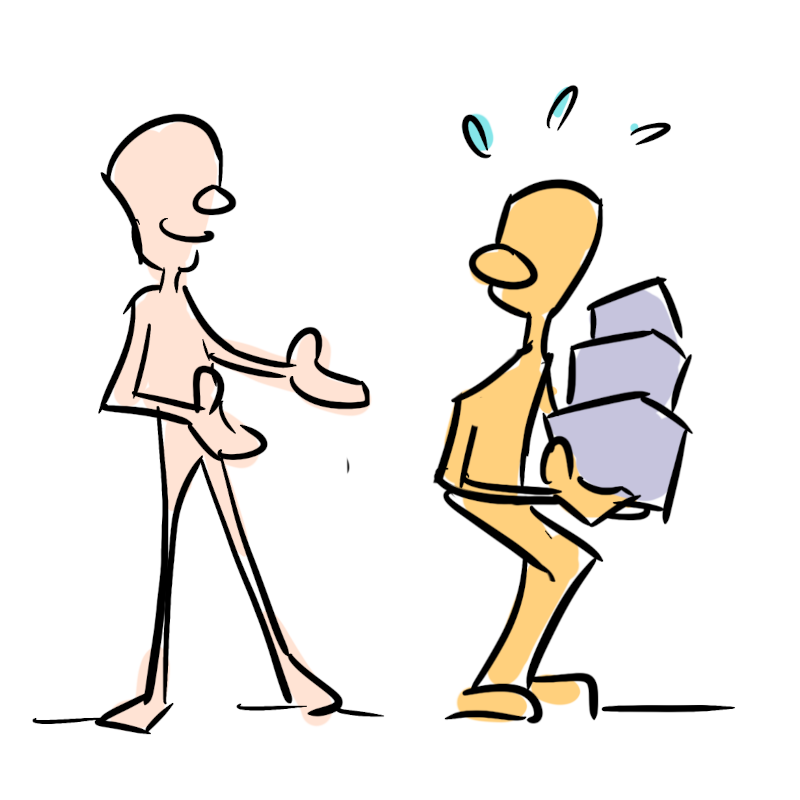
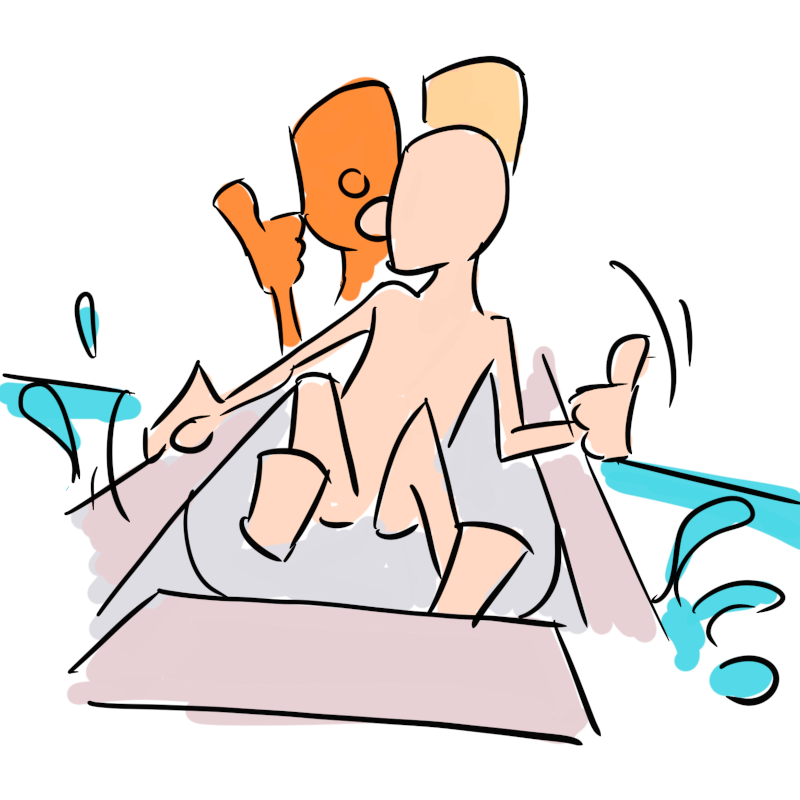
One company I interviewed at had a final three hour interview, the first hour of which was a slideshow presentation. The recruiter suggested I “tell a story” to engage my audience. Taking him too literally, I drew a bunch of quick sketches to illustrate my take on managing a software development team ( the position was for a Software Development Manager ). After my presentation concluded I was met with blank stares and silence, like I farted loudly in an empty concert hall. The hiring manager just said, flatly, “Did you even read the instructions?” Needless to say I didn’t end up getting the job.
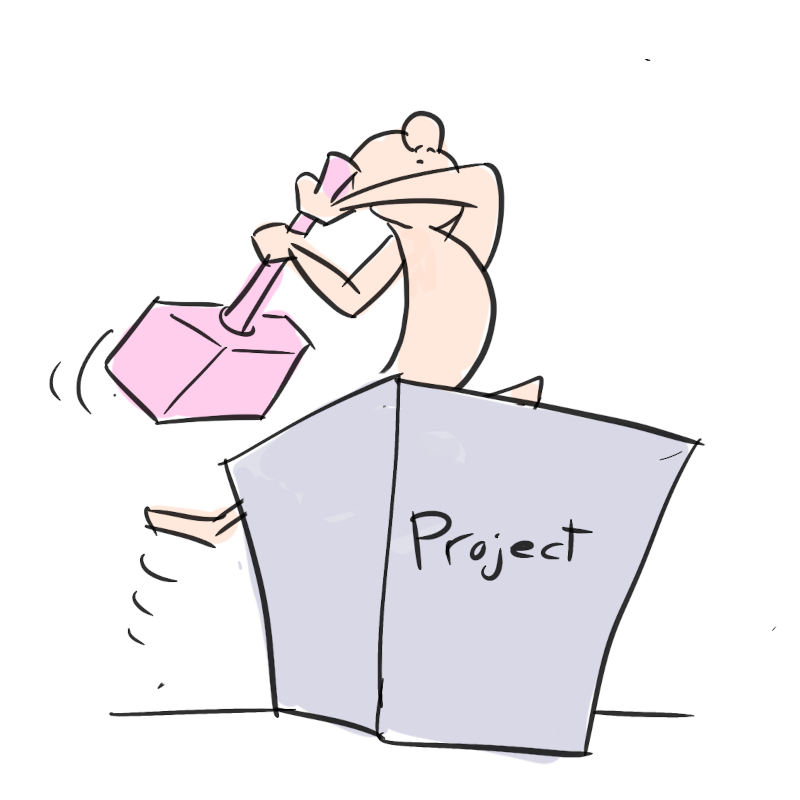
Are we there yet? There are many obstacles before you can deploy to production.
Always break up projects into manageable pieces that can fit into a 2-week sprint.
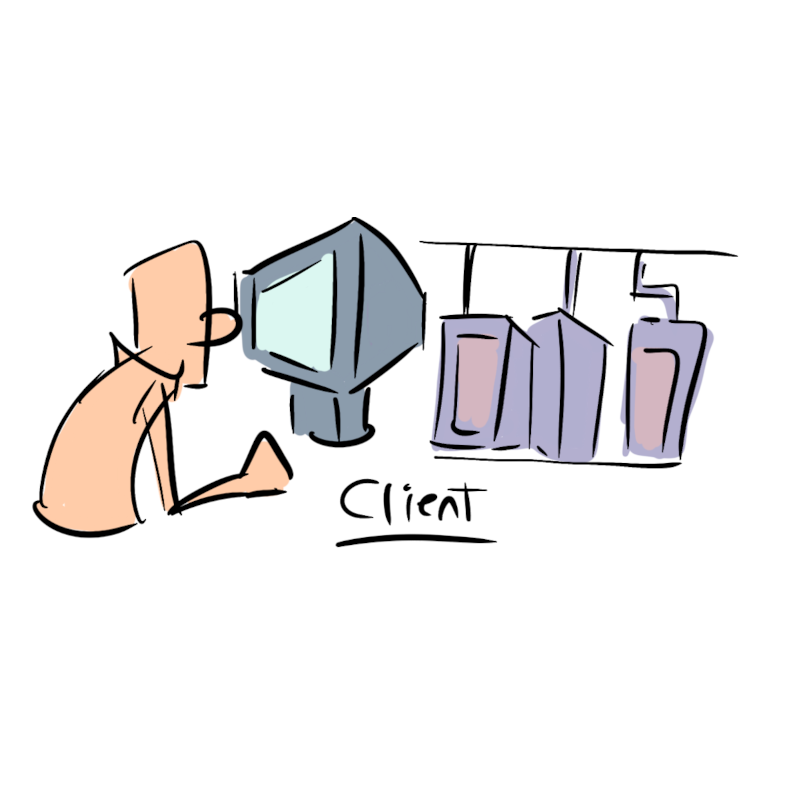
The client is just one of many stakeholders.
Licensing is a constraint to successful projects.
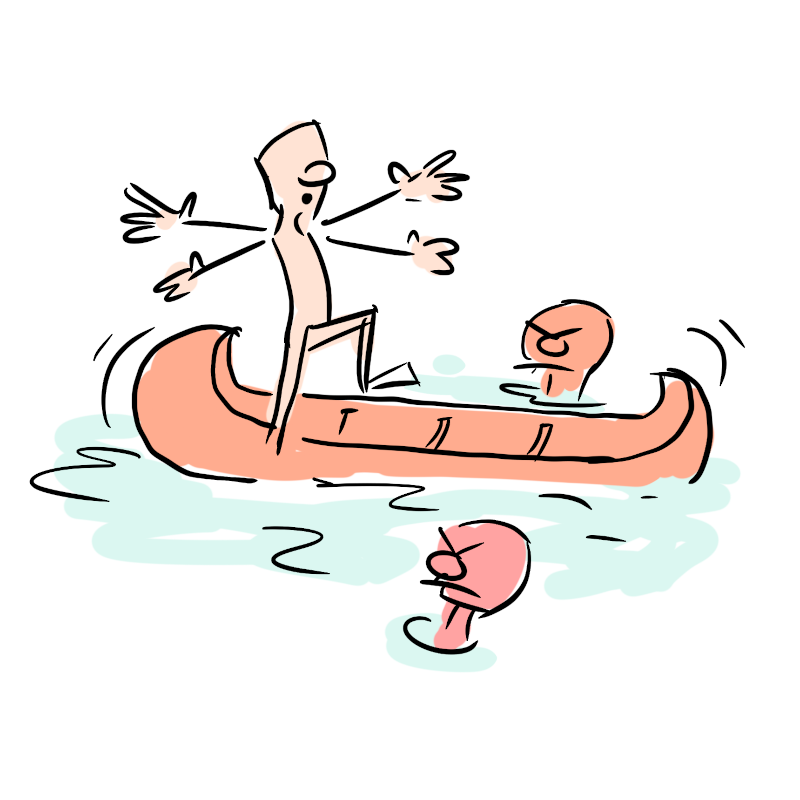
As an incoming manager, don’t rock the boat until you first determine how it’s floating.
There are lots of different sources of information an onboarded team member can learn from.
It’s not always a technical problem. Sometimes, it’s morale.
I thought it was a technical problem …
Always keep offshore teams engaged.
Keep the [ sprint ] board clean.
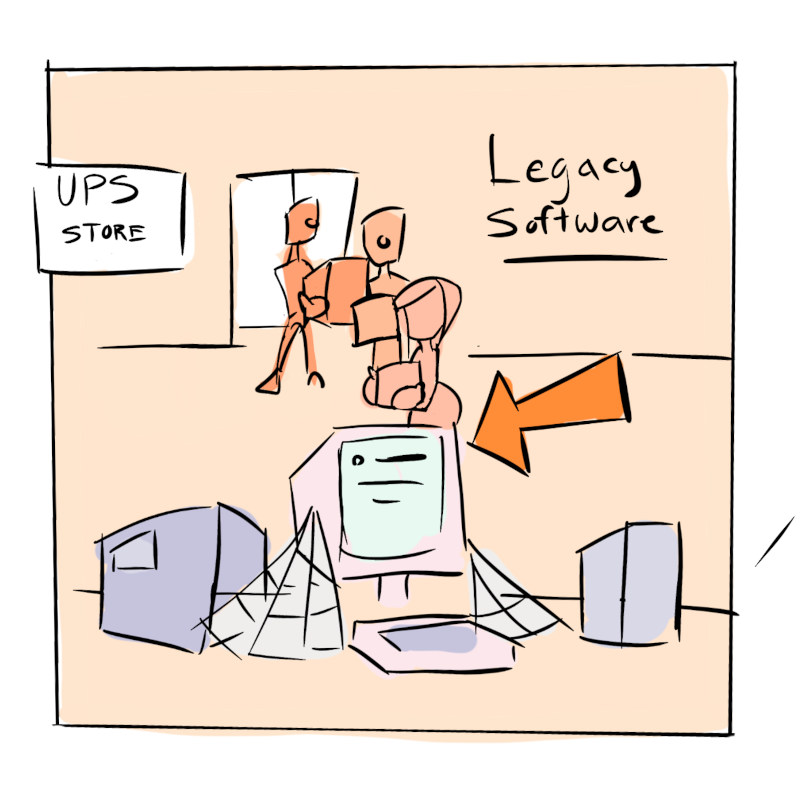
Sometimes it’s a legacy [ software ] problem.
Make first contact with the product owner and manager as soon as possible.
Meet regularly and see how you can help.
Only rock the boat after you’ve had a chance to study it first; you’ll get more support from your team.
I have a friend, Richard. Over twenty years ago we worked together at a small software startup in Kearny Mesa. Since then Richard has delved into real estate and investments, while I’ve continued down the path of a software developer. We hadn’t talked in a while, so we agreed to meet up for coffee about a year ago.
“I’ll pick you up.”, he offered.
“You sure?”, I asked.
“Yes.”, was his response.
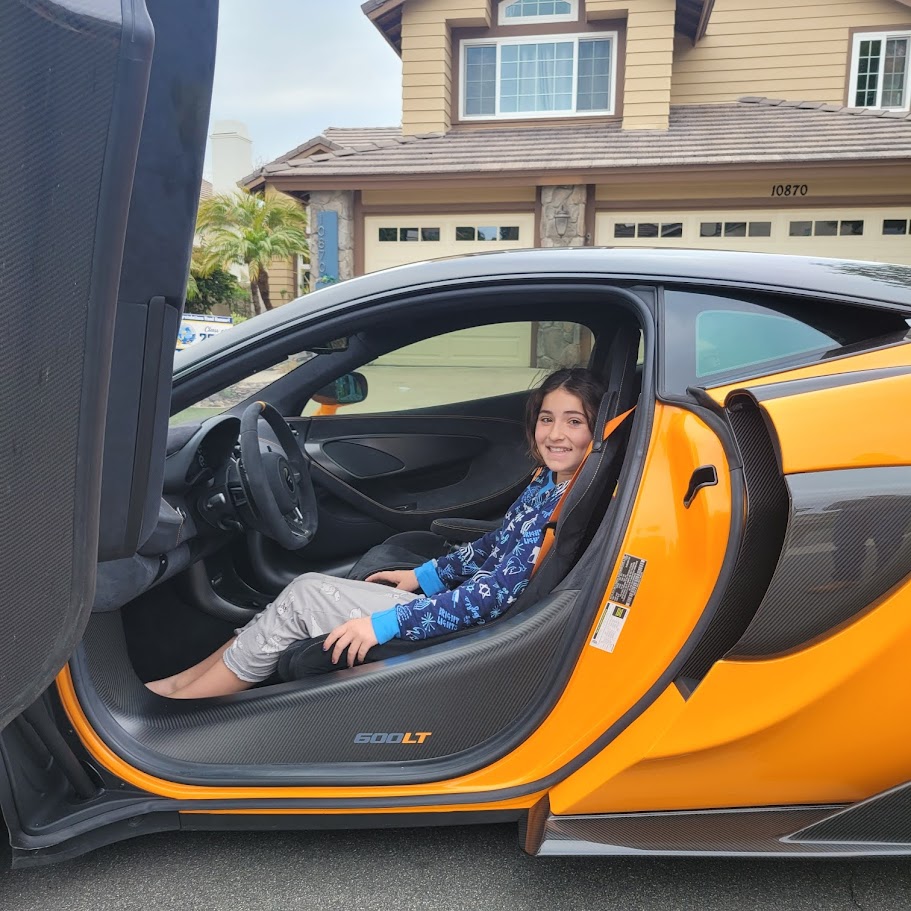
A few days later he rolled up in front of my house in a bright orange McLaren supercar. It stood in stark contrast to my current ride, a 2010 Chrysler Town and Country ( yes, that Town and Country ).
In the blink of an eye my daughter, Kaylee, who had been watching from the living room window, ran outside and pleaded to sit in the driver’s seat.
Kaylee, in Richard’s McLaren
After Kaylee was pacified I climbed in and Richard and I headed for coffee.
After swerving to avoid anything bigger than a pebble, I realized that supercars come at a cost.
“Your ride is cooler, but mine is way more comfortable.”, I told him.
“But overall, you seem to be, uh, doing well”, I continued, looking around the interior of his car.
He smiled.
Over coffee we discussed several things, but focused on a project that he wanted to build and launch. He wanted to bring to market a digital guestbook, and was looking for help.
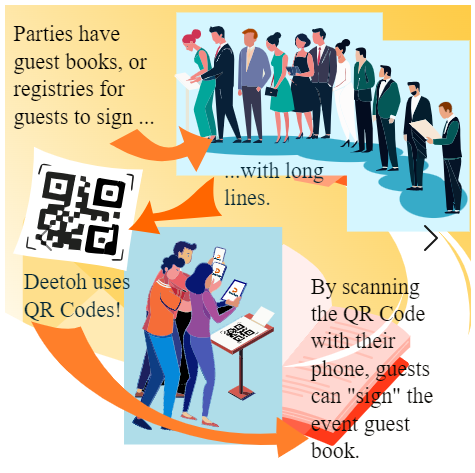
He explained that it could be used at weddings, birthdays, baby showers, etc.., to streamline the process of registering at the party, making it easier for the party’s host to send correspondence.
“Instead of signing a physical guestbook, guests will photograph a QR Code. The QR Code will redirect them to an online guestbook.”, he told me.
The ubiquitous QR Code, a modern day bar code you can cram full of data.
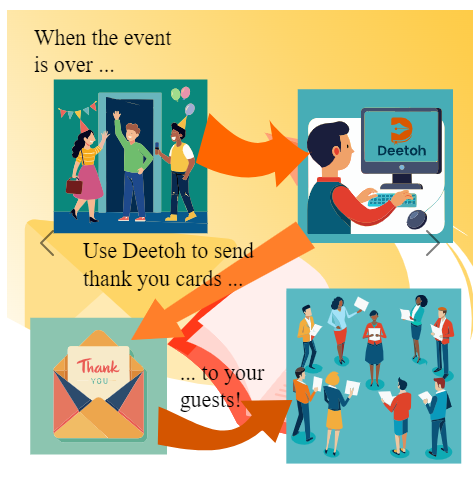
“Then, after the party is over we can automate emails to all of the party’s guests”, he continued.
Without thinking I uttered the words no developer in their right mind should ever say.
“That sounds easy…”, I told him.
And then I uttered the other words no developer in their right mind should ever say.
“It shouldn’t take too long.”, I told him.
Richards’ proposal was timely.
I had studied Software Engineering in college for the creative aspects: the ability to create something from nothing. For the last year I had been working as an Application Development Manager, and, although the role offered me the chance to mentor other developers and plan and guide projects, it didn’t leave much time to, well, to create. Furthermore, I felt my programming skills stagnating, as well. So, when Richard asked me if I’d like to partner with him, I jumped at the idea.
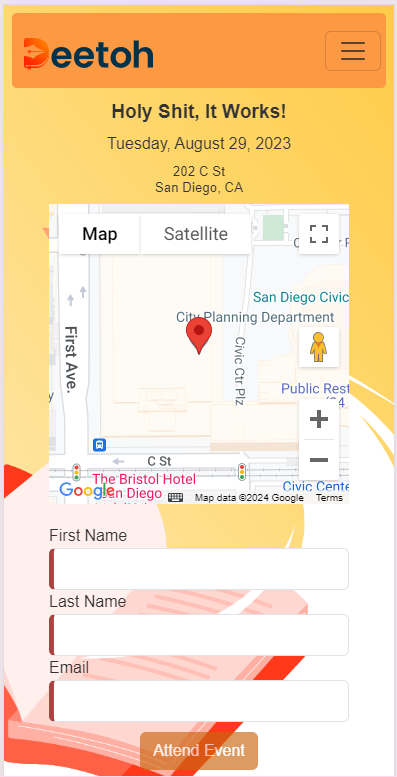
A year later we launched Deetoh, Rich handling marketing and legalese, and I the software development. Here’s the link :
I decided to use Azure, .NET Core, Angular, and Bootstrap for Deetoh’s technology stack to create some synergy between Deetoh and what I was doing at my employer, a .NET shop with Azure “cloud” aspirations.
I have been using Angular since its initial implementation a decade ago, so no problem there. Bootstrap, too, although I would be using it foremost for its “mobile friendly” layout engine, and secondly for its UI components. Deetoh was to be a “mobile-first” application, after all.
I have been using .NET for over twenty years. Back then ASP.NET Web Forms and MVC were king. For Deetoh, however, I’d only be using it to create Web APIs – or, REST APIs that the Angular front-end could consume. In retrospect, I probably should have opted for Azure Functions as hosting a Web API as an Azure Web Service on Azure is pricey. Given Deetoh had no established audience, pay-as-you-go Azure Functions would have been much much cheaper in the short term. On the other hand, .NET Core, which Deetoh’s Web APIs were built upon, can be run as Linux Containers on Azure. Initially, I had everything running on Windows on Azure. After realizing I could migrate to Linux and cut my hosting costs in half, I switched.
Admittedly, Azure was new to me. At my prior employers I had used Amazon Web Services. What I found is that for every product offered by AWS, Azure had a doppelganger.
I used Azure AD B2C and MSAL for user management and token-based authentication. This project provided a good foundation for my Angular front-end. Azure B2C provided user flows for registering new users, signing in, and password resets. My only complaint is that it proved to be a little lacking in custom claims. The JWT tokens generated by Azure B2C were limited to the standard username, address, phone number, etc….
For security, I would rely on Angular Guards to authorize access to each of Deetoh’s routes. The Guards would leverage the MSAL library to “sniff” the token generated during sign-in. On the backend, the WebAPI would also use MSAL to restrict access to the various REST endpoints based upon the same token. So, even if a user were able to circumvent the front-end’s security, they wouldn’t be able to access any data on the back-end.
My .NET Core Web API would consume Azure’s NoSQL database, called Cosmos DB, using Entity Framework. In retrospect, using an ORM was probably overkill, but the implementation would be sparse and straightforward given the flat, non-relational nature of NoSQL, so I figured, why not?
To support Deetoh’s emailing of guests I used Azure’s Email Communication Service and a Storage Account. At my employer I’ve used SendGrid for sending emails, but SendGrid only offers up to 100 emails/month for free. After that it’s $19.95/month. Knowing that I’d likely blow well beyond 100 emails in testing alone I opted for Azure’s platform, which charges a flat fee of $0.00025 per email. Azure’s service doesn’t have as much polish as SendGrid, but so far it’s worked out well.
“If Deetoh ever gets enough traffic so that our costs increase enough to warrant a revaluation of our platform, our service providers, or even a refactoring – I think it’ll be a good thing!”, I joked with Richard.
That’s not to say Deetoh isn’t production ready, but if it miraculously receives traffic rivaling Evite overnight, there will definitely be growing pains. Obviously, I don’t expect that. Don’t build a cruise ship when a sailboat will suffice, right?
A little help from AI
About a month before launch Richard was demoing Deetoh to a couple of his friends that wanted to use it for their upcoming wedding. At the time Deetoh was fully functional, if not a little rough around the edges.
“It needs a better help experience”, he told me. “They didn’t know how to use it.”
At this point Deetoh’s system consisted of little help bubbles that could be toggled on-and-off. Richard, however, wanted full page overlays with rich graphics.
“Who is going to do the artwork?”, I asked Richard, already knowing the answer.
If you’ve been following my website long enough – heck, just by the website’s name alone, you probably realize that I am an artist, too. However, at this point I had already revised Deetoh’s email feature twice per Richard’s request, and just wanted to launch. After sketching up what I wanted the help pages to look like I quickly realized the custom artwork was going to take a lot more time than I was willing to spend. I started perusing the web for open source artwork, but realized that I’d never find content specific enough. Then I tried AI.
AI is an acronym that has been met with both fear and excitement. As a software developer, I’m scared that someday it might be able to render code well enough to replace me, yet I am excited by its possibilities as a tool I can use to speed up my daily work. As an artist, I discovered the same fears, only multiplied. I have little doubt that in less than five years the majority of corporate artists will be replaced by AI. Keep in mind I say “Corporate Art”; this is the “generic” kinda’ stuff you see on internal memos, training videos, and the like. Anything public facing will undoubtedly undergo more scrutiny. For Deetoh, however, AI just worked. With the help of a mobile application called Recraft I was able to generate specific-enough content for Deetoh’s help pages. Admittedly, I still had to make alterations ( i.e. “nip and tuck” ), but overall it took me easily a quarter the amount of time. As far as the alterations? I vectorized the AI-generated imagery using Adobe Express Online and manipulated the resulting graphics using Inkscape. Here’s a sample of the end result. What do you think?
Closing thoughts
Deetoh took a lot longer than I expected. At most jobs I’ve worked I’ve taken to doubling my estimates and then some when determining how long something will take. Rarely, have I come under ( or over, for that matter ). For Deetoh, I went over. Way over. Why? It came down to two things :
A simple misunderstanding between what Richard, the product owner, wanted, and what I built.
An inability on my part to determine how many hours a week I could dedicate to the project.
Ironically, these two problems plague every single software project that I have led or worked on. Part of the problem is Agile Methodologies, or incremental / progressive development. Agile doesn’t leave a lot of time for proper design. However, I’ve worked on way too many waterfall-based projects, Agile’s polar opposite, where all planning is done up front, to realize its faults, too. I’ve seen Waterfall stall out before a single line of code, much less a prototype, saw the light of day. With Agile, the focus is in delivering something, anything.
Aside from governance, developing Deetoh gave me a renewed respect for Cloud to leapfrog development. There was a time not so long ago where I would have had to provision my own servers, my own user management, my own database, my own authentication, and so on. Now, I can do it relatively quickly ( and cheaply ). Cloud is not just for large corporations, but for the little guys, too – like Deetoh.
I’m kind of attached to the stuff on my desk. Apparently my stuff is, too….
Last year Jodie bought me a diffuser for my office. It did an amazing job of masking the funk of two dogs and, well, me, until it didn’t. Turns out, just like milk, essential oils can “turn” if left in a diffuser for too long. Jodie started buying me candles shortly after that revelation. Thing is? Candles don’t last that long. Now instead of a smell problem, I have a jar problem.
“Jodie! I’m accumulating jars from all of the burned out candles you have been bringing me.”, I announced from my office.
I looked back at my desk. My lamp stooped over the carcasses of empty jars cluttered around it, its light reftacting off of the colored glass.
“It looks …. kinda sad”, I thought to myself.
“Can you use them as planters?”, Jodie called back from downstairs, interrupting my thought.
“Good idea!”, I called back to her.
But first I have a better idea…”, I thought to myself.
An illustration I drew for a book my friend Kevin and I are working on. It portrays the powerful, but weary Dragon King staring down the evil sorceress, Karakow.
“If the only tool you have is a hammer, you tend to see every problem as a nail.”
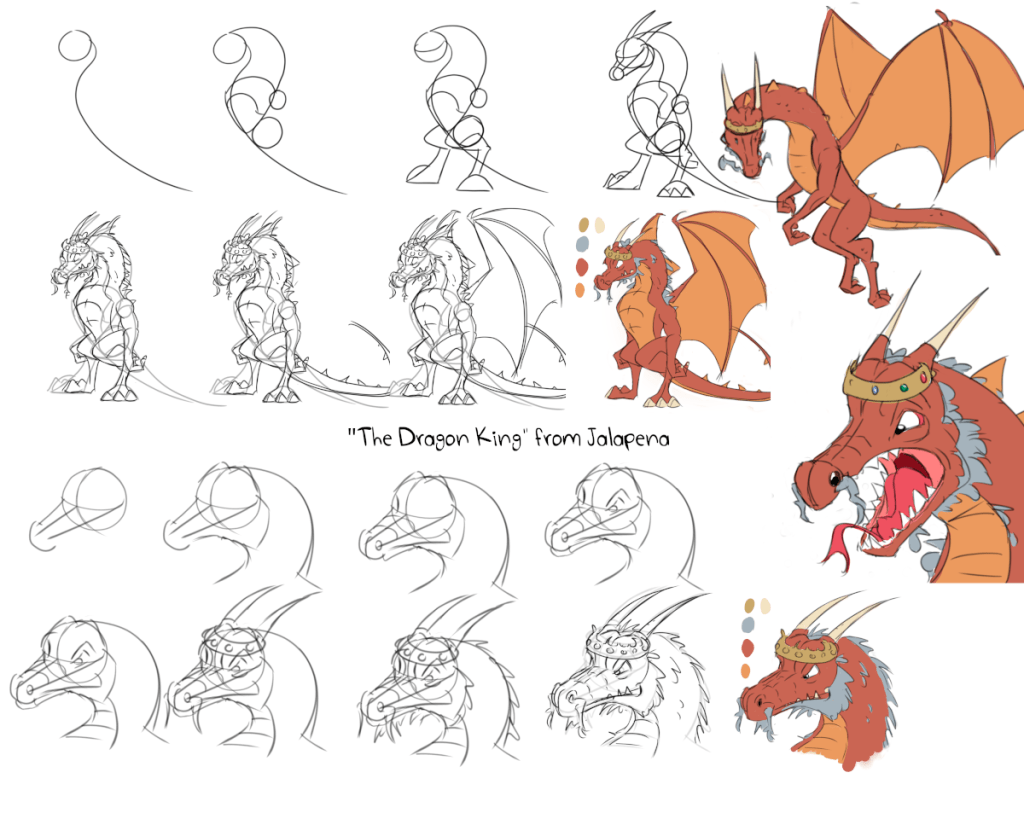
My first hundred or so sketches of dragons looked either like anthropomorphic dinosaurs, or “Bowser” from Super Mario Brothers. The problem, as the quote so eloquently states above, is that I tend to draw what I know. Fortunately, as luck would have it my family and I visited “Book Off!”, a used book store in the Kearney Mesa area of San Diego a few months ago. While my daughters searched for Manga and Anime, I dove into the art books and discovered a used, tattered, and very cheap copy of “DragonArt” by J “NeonDragon” Peffer. For a couple of bucks Peffer’s illustrative step-by-step book showed me that there were other tools at my disposal than hammers. It still took a few sketches but I finally got a design that I liked for the Dragon King : Haggard, yet powerful. Intimidating, but intimidated.
Karakow
Karakow was a little easier. She’s an aging sorceress that’s one of the main antagonists in the book. I couldn’t help but lean heavily on Disney’s villainess’ such as Cruella de Vil and the evil ( unnamed ) stepmother from Cinderella. What I came up with is the vain, unyielding woman below. She has sharp, angular features, a big crooked smile, and a wardrobe that is conservative yet loud at the same time.
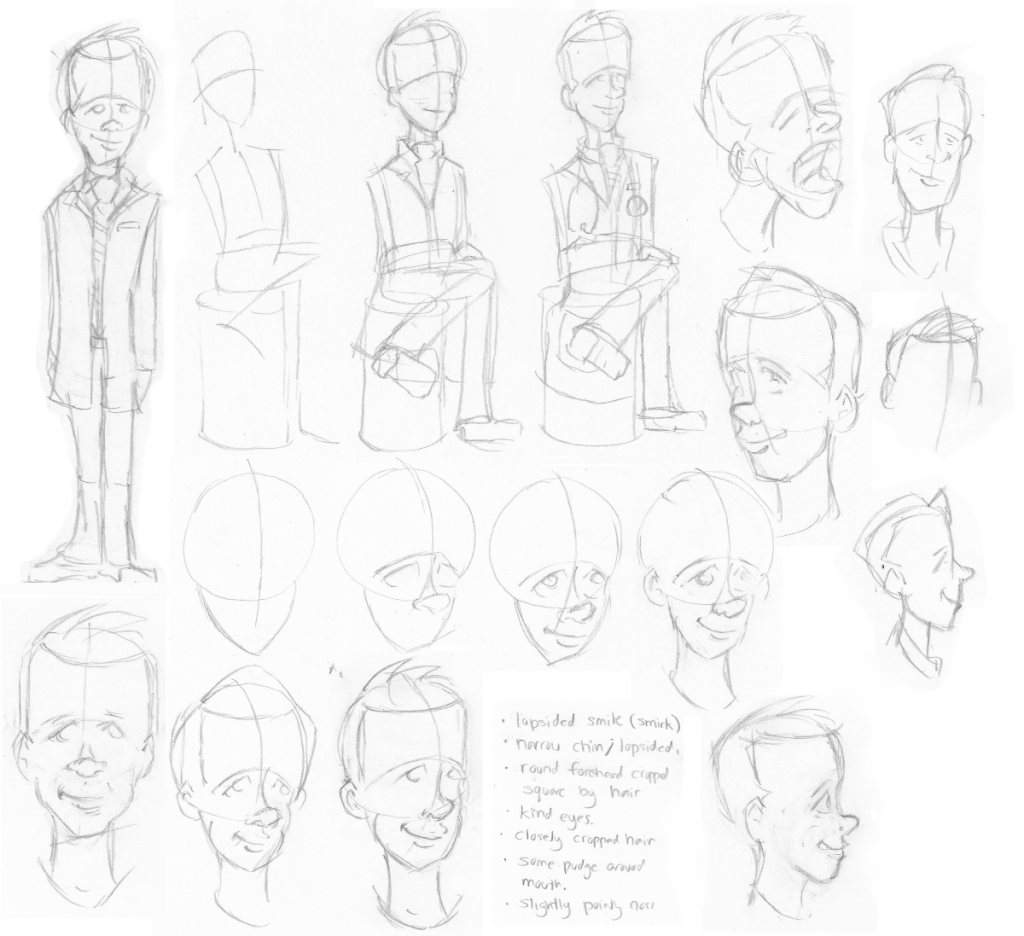
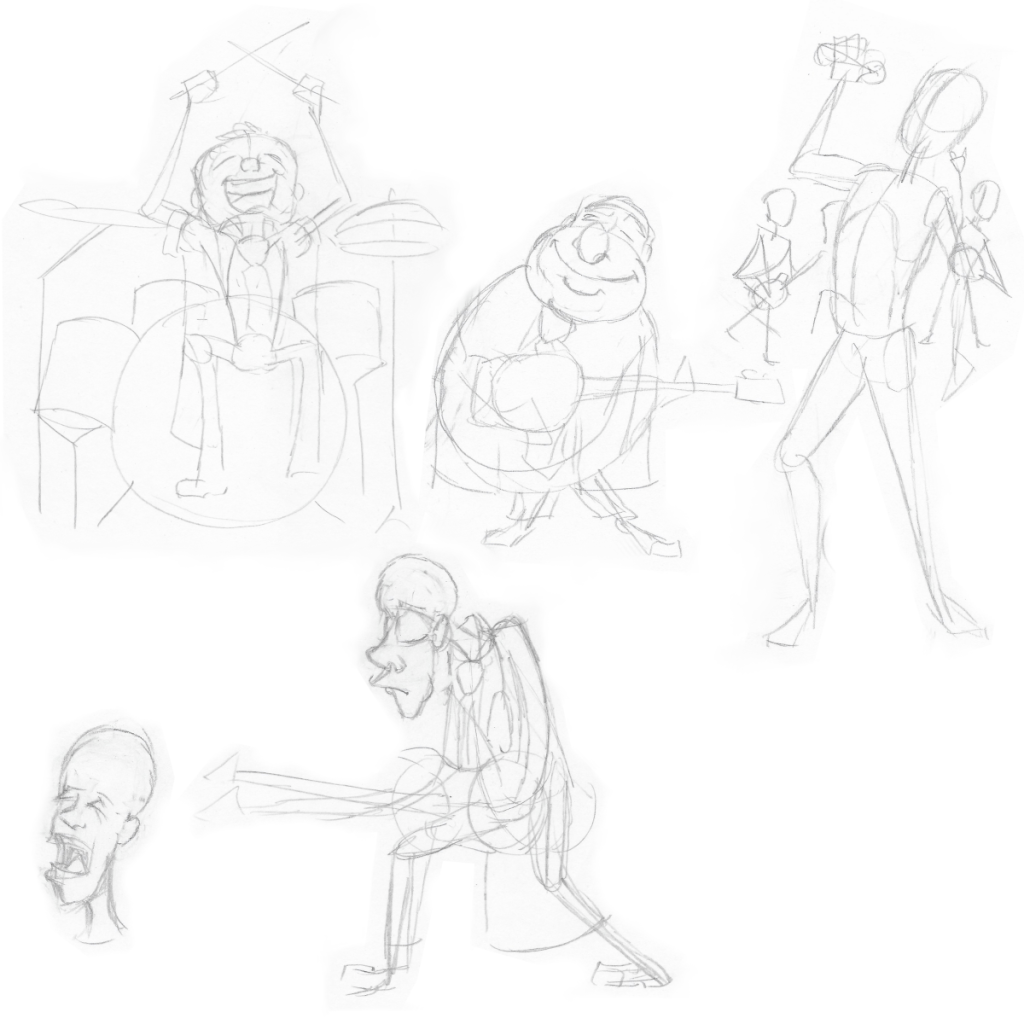
As always, I like to include some of my rough sketches and design work. As a budding artist I always try to remind myself that behind every finished work is lots ( and lots ) of hard work and mediocre barely-coherent scribbles. Admittedly, the “scribbles” shown here are some of my more refined ones. Trust me, there’s a lot more in the trashcan on the floor next to me.
New toys!
In other news, I broke down and bought an iPad Pro and have started working in Procreate. My old setup was a Surface Pro 7 running Clip Studio Paint. Why the change?
First, although compact, the Surface Pro 7 is far bulkier that the iPad. Although it’s a fully functional Windows machine, it makes for a mediocre tablet, a jack-of-all-trades / master-of-none, per say. Menus are tiny and finger gestures ( pinch-and-zoom, for example ) aren’t always responsive.
Second, the Surface Pro 7 only supports the original Surface Pen, a instrument that requires so much software-enabled “line correction” to function that I never really felt like I was working with a drawing instrument. The Apple Pencil, aside from a slippery glassy screen, is remarkably better in every way.
Third, Clip Studio Paint went subscription-based for it’s latest version. I blame Adobe for this trend and I refuse to subscribe to any of its software products because of it. Clip Studio Paint, like Procreate, was initially a one-time purchase. Now? No longer, so bye-bye. Subscriptions are for magazines that have new content each month. Software, by nature, is far more static; even if new features are introduced I seldom use them. And if they’re good enough? I have no problem buying a new version. Outright. Without a subscription.
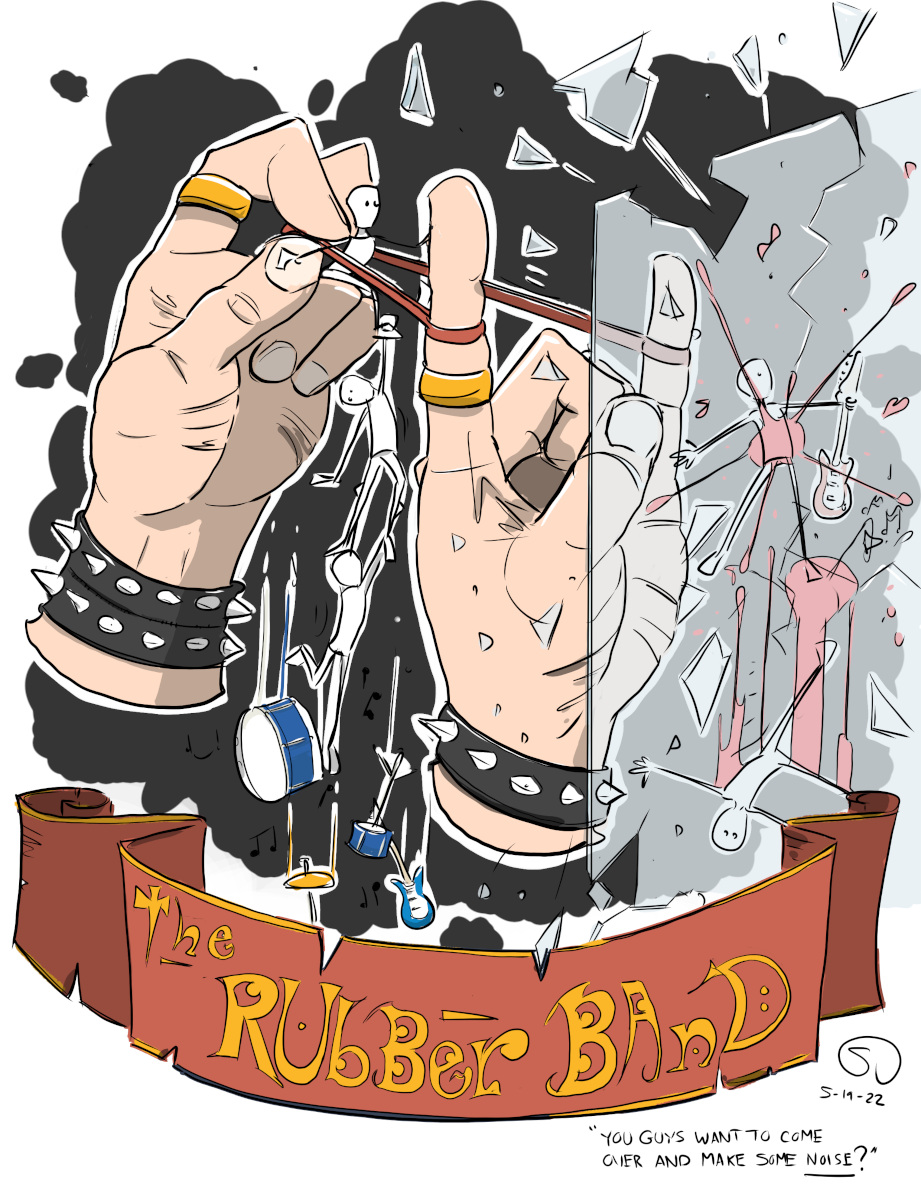
A logo I created for the Dad-based Garage Band that I am in. It’s based on a vector image that I created, but rasterized with some distressing thrown in.
I have been playing guitar with a group of dads in a garage band for a little over a year now. What started out as a breakout session in the bedroom of my friends’ sons’ bedroom has grown into a full-fledged 5-person band. Although we try to meet weekly, a plethora of other dad-related duties compete for our time, making our practices inconsistent at best, but we try. Our adoring fans include passers-by and neighbors, either too young to know good from bad, or just too curious to turn away from the train wreck/spectacle that is transpiring in the garage.
We call ourselves “The Rubber Band“.
Part pun. Park joke. The Rubber Band expands to accommodate – whether that be each others’ schedules, talents, or even new members wanting to “give it a try”. The truth is? We’re not all that good, but we sure have a great time not being that good.
Thank you Shawn Burgwald ( Drums ), Kenn Matthews ( Vocals ), Mike Jock ( Bass ), Todd Vandervort ( Guitar ) and to that 20-something couple walking their dog three months ago that decided to pick up the open mic and join us for a song.
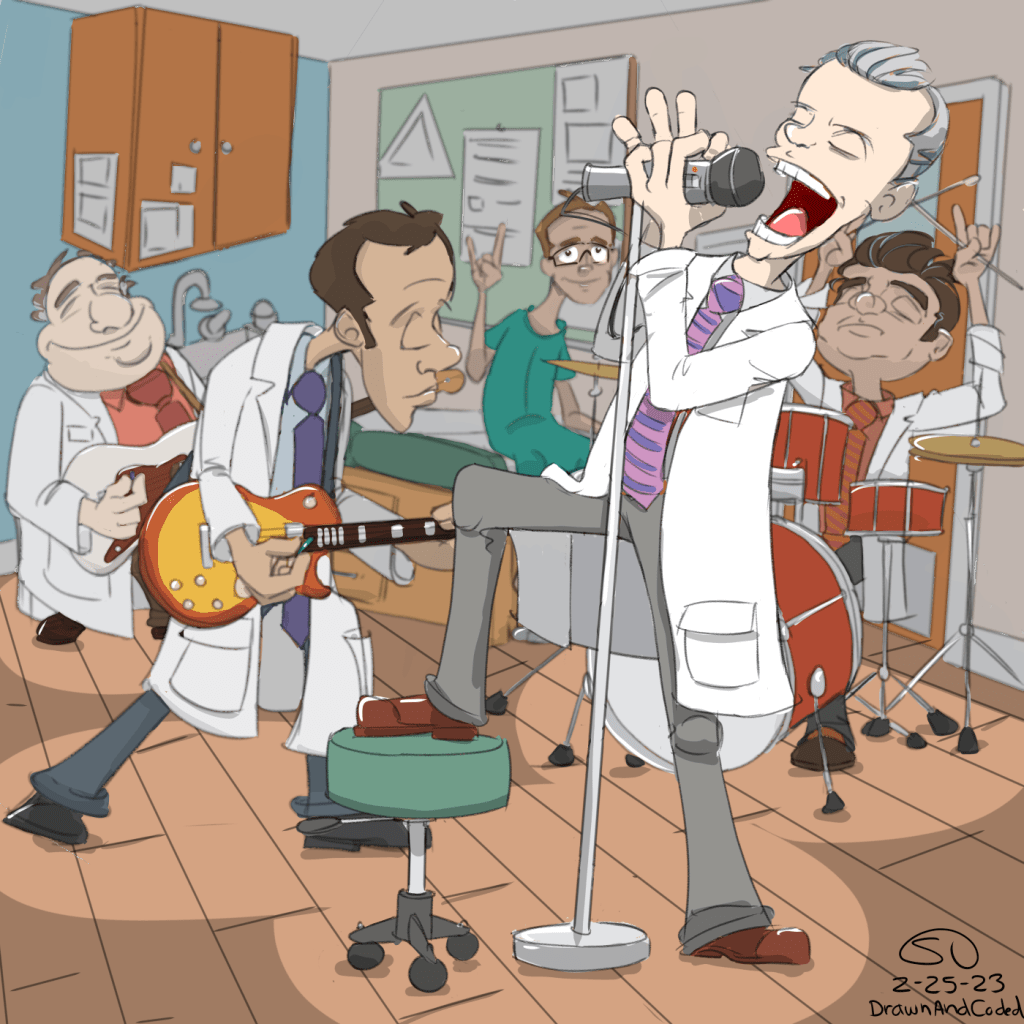
My oncologist is in a rock band. This is kinda’ how I pictured it.
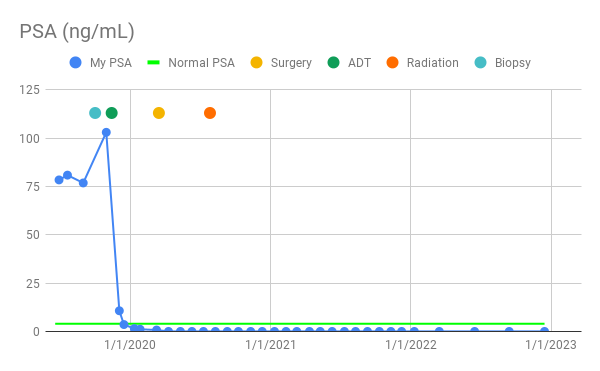
It’s been well over a year since my last treatment for prostate cancer, and, as of my last quarterly blood draw, my PSA is still undetectable ( < 0.01 ng/mL ). If there are still prostate cancer cells floating around inside me, they’re in smaller amounts than the PSA test can detect. I am in remission, where I hope to be for a very, very long time.
Although my medical treatments have been mostly paused ( more on that in a bit ), I still find myself sticking to the same routines and diet that I kept while being treated. I still maintain a Whole Food Plant Based Diet ( WFPB ) and abstain from alcohol and processed sugars, but I’ve started allowing myself the occasional serving of fish. I’m still a big fan of intermittent fasting ( IC ), but I’ve found myself indulging in breakfast again from time-to-time.
I also continue to exercise, probably more so than while being treated. With the cessation of hormone therapy came a surge in testosterone, so I’ve bumped up my exercise and weight routines, probably a little too much. Back and muscle pain has been a problem made worse by working a desk job. I’ve started doing daily stretching/yoga, bought a standing desk, and even started seeing a chiropractor to help loosen things up. Admittedly, each time I pull my back out I can’t help but think that it’s cancer-related, but eventually I come to the same conclusion : I’m just getting older – and probably overdoing it. If there was one upside to the hormone therapy I was on, it was the steroids I had to take while on them. In retrospect, I feel that they likely masked a lot of the muscle pain I am now experiencing.
“Yeah, my latest bone density scan (DEXA) was a little lower, wasn’t it,” I admitted.
“I don’t get it! I exercise. I eat a high calcium diet. I even started running – well, for a while.”, I complained.
“I don’t want you to break your hip at 50.”, he said, flatly.
“Yeah, I know. I know…..”, I grumbled.
“So much for my so-called ‘Non-Treatment Plan'”. I thought to myself.
“Hey, are you still in a band?”, Dr. Stewart asked, turning away from the computer screen.
“Huh?”, I mumbled, distracted.
“A band? Are you still playing music with your friends?”, he asked again.
“Oh… yeah! Yeah, we get together every week. We’re not very good, but we have a great time not being very good!”, I exclaimed, “Why do you ask?”
“The other doctors and I started a band, too!”, he smiled from ear-to-ear.
“No kidding? That’s awesome!”, I said, matching his smile.
“Yeah! It’s me and some of the other oncologists.”, he continued.
At this point my imagination took over. I pictured a Gary Larson-esqe comic of doctors in lab coats rocking out in an exam room, stethoscopes swaying haphazardly from their necks.
“Check this out!”, he smiled.
He then showed me a video on his phone. It wasn’t exactly how I pictured it, but they sounded good, and, wait…
“Are you singing?”, I asked, raising an eyebrow.
“Yeah, I’m the lead singer!”, he said, with pride.
I laughed, encouragingly.
“You guys aren’t half bad. I love it!”, I added.
We talked a while longer, mostly about lingering side effects from surgery and radiation. You can’t rip out a prostate and bake the carnage with radiation without lasting damage, after all.
Fortunately, some of my concerns were mitigated by a routine and uneventful colonoscopy last year. Radiation might have baked my prostate, but my colon, aside from some scarring, survived unscathed. At this point I’ve gotten used to the frequent bathroom trips at night and the inevitable burning sensation from eating spicy foods. Incontinence following surgery hasn’t been a problem, but not for lack of effort – I still do daily Kegel exercises for twenty minutes, and I’ll probably be doing them for the rest of my life. There are other problems, but Dr. Stewart has a treatment plan for those too, and I’m slowly coming to terms with it.
“Well, that’s it, I guess.”, Dr. Stewart said as he got up to leave.
I got up to follow him.
“You can head out, too, but Danielle will be in shortly with your paperwork.”. He smiled.
“Yeah. I’ll stick around, I’d like to see her!”, I said.
Danielle, Dr. Stewart’s nurse, has been by my side for the entire ride. Admittedly, she’s spent a lot of that time behind me administering injections, but she always had the most awesome cheerful disposition – and never missed, either.
“You look a lot different without a hazmat suit on and a horse needle in your hand!”, I told her as she entered the room.
She laughed and we caught up for a few minutes before I headed out.
On the way home I stopped to pick up Poke Bowls at “Poke One N Half” in La Jolla. Jodie and I had started frequenting the restaurant three years ago following each of my appointments. I’m not a big fan of sushi, but visiting the place had been a way to unwind after what had been some pretty stressful discussions.
“Wow, your prices have gone up!”, I told the cashier while paying for the meal.
“Inflation”, she responded, flatly, spinning around the credit card machine to reveal a screen requesting a tip amount.
I entered a tip and pressed “Enter”, my eyes bugging out slightly at the total bill.
“Well, at least I only have to do this every 6-months now, ’cause that was expensive.”, I said under my breath.
Yet one more reason to be thankful to be in remission – as if I needed another one.
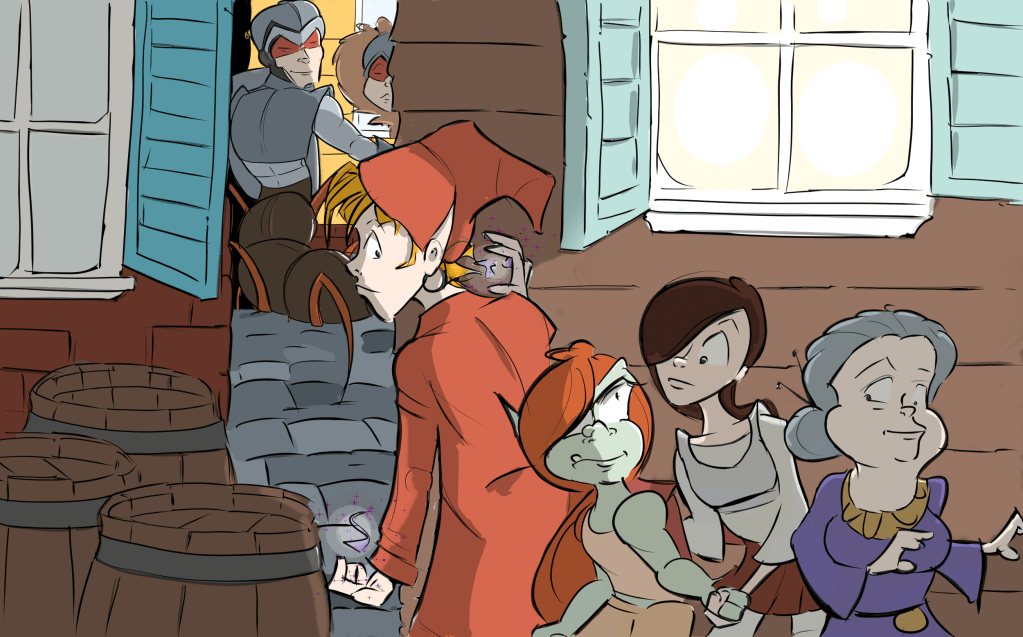
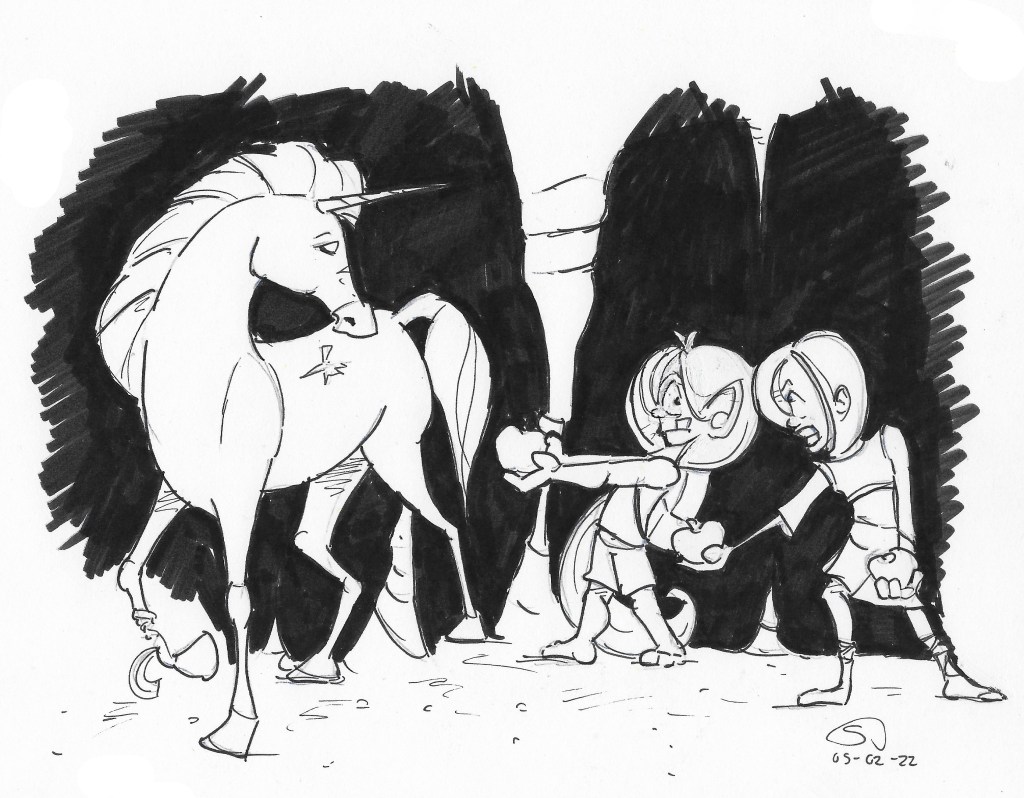
I drew these pictures for Kevin and my ongoing endeavor, a children’s book, titled “Jalapena”. If the name sounds familiar, that’s good, because my last post was over eight months ago. If not, well, it’s a story about a young troll, Jalapena, and her human friend, Raven, as they journey to save their world by means of saving a unicorn. Kevin based it upon stories he told his daughter when she was younger.
As per my last post I’ve been putting a lot more effort into drawing “au natural”, with pencils, pens, and paper. The first two drawings were done entirely on my Surface Pro using Clip Studio and Gimp. The later three were done using a blue pencil, an HB pencil, Micron Pens, and a sheet of printer paper. It takes a little more work, but is a lot more rewarding for me. At some point, if there’s enough interest, I’ll do a quick post on my process.
Take care. Stay healthy. Live life.
-Scott
Jalapena, Raven, and their new companions, a couple of wizards named Tholaman and Choinard as they evade the evil Bolziks in the town of Abbington.I’m a big fan of noisy family meals and wanted to sketch what such a meal would look like in Jalapena’s household. This is what I came up with.Six years into my self-bestowed title as “amateur illustrator” and you’d think I’d have drawn a horse – uh, unicorn by now, but nope. It took some effort. Maybe I’m a little biased, but my initial sketches all looks liked long-legged dogs. It’s been said that for every good picture there are thousands of bad ones leading up to it. I have stacks of bad horse pictures, maybe not thousands, but enough to make a equestrian whinny. I hope you like them.

























 drawnandcoded.com