

#toiletpaper #rationing #shortage #coronavirus #charmin #drawnandcoded #comic
#toiletpaper #rationing #shortage #coronavirus #charmin #drawnandcoded #comic
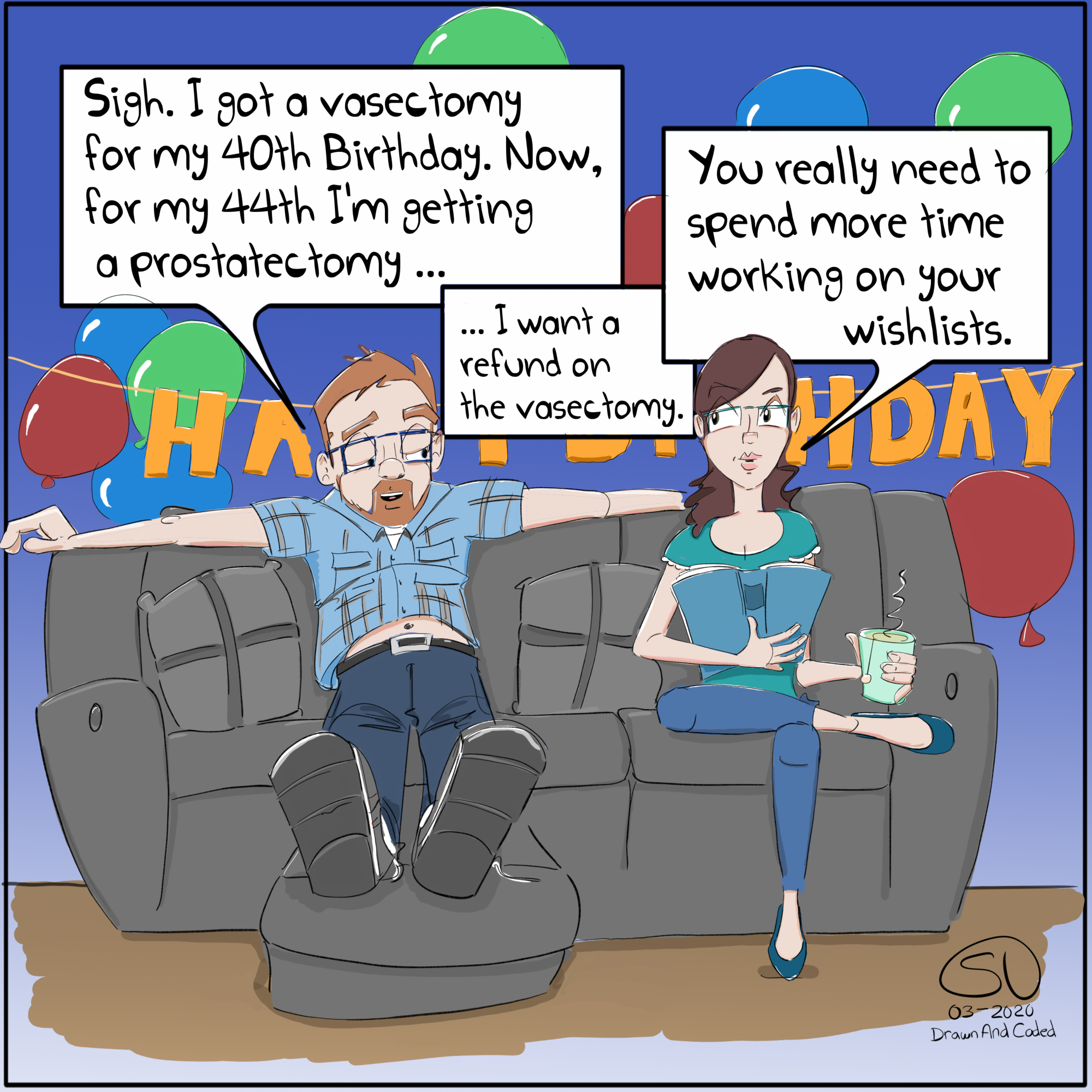
“Wait….WHAT did you just say???”, I asked, bewildered.
“Lora thought that your surgery was going to be performed through your ‘taint‘.”, Jodie replied.
I couldn’t help but laugh a little.
For those of you who are just joining me on this crazy little adventure, I was diagnosed with Stage 4 Prostate Cancer last October. Next week, on March 16th, I am scheduled to have a radical prostatectomy, or the removal of my prostate.
Now, back to Lora.
Being a good friend of mine with a great, if not odd, sense of humor, I felt like some enlightenment might be in order. A quick text exchange ensued …

“Okay, I think I set her straight”, I told Jodie, chuckling.
“By the way, you know how some people undergoing knee replacement Sharpie their knees prior to surgery to make sure the surgeon operates on the correct knee?”, she asked me, with a smirk.
“Uh, yeah…”, I replied, cautiously.
“How about we Sharpie your balls beforehand with big ‘NO’s. You know, just to be safe?”
Ha Ha.
Okay, friends and family. Here’s the thing: Although I appreciate the humor and laughs, the comedic doors are closing quickly. Post surgery, a belly laugh will likely make me pee my pants or, at worst, bust a stitch.
Who am I kidding?
Roast away.
I love you guys. I’ll just have to stock up on pads and diapers …
“I’m pretty sure I just bought a 200 dollar bottle of soap.”, I told Jodie while leaving a very quick pre-op appointment with Dr. Christoper Kane’s nurse practitioner.
His nurse had handed me a large bottle of pink soap. It looked alarmingly like the same stuff that dispenses from a gas station restroom.
“The insurance will probably pay for it…”, Jodie replied.
I haven’t had major surgery before so I was a little surprised that an intensive bathing regime was in order beforehand. I was told to shower using the soap twice the day before surgery and once on the day of the surgery. Each of those times I also need to lather, rinse and repeat. She also instructed me to make sure my sheets were freshly washed as well as the bath towels and any clothes I will wear the day of surgery.
“My surgery is at 5:30 AM. I’ll have to wake up even earlier to hose down!”, I complained.
“….and you’ll be sleeping the rest of the day.”, she replied.
Good point. I’ll be sleeping under general anesthesia. Jodie, on the other hand, will be doing anything but that.
Sigh.
“This is addressed to you…”, I told Jodie, slapping down a fat envelope addressed to her.
She cut open the envelope to reveal several gift cards for The Loving Hut, one of our favorite vegan restaurants.
“Gift cards?”, she looked up at me, “But from who?”
A phone call later revealed that the Meal Train had left the station and Jodie’s best friend from High School, Jenny and her husband Adam had decided to take a ride. Jayme, Jodie’s twin-sister, had set up the Meal Train to help us out after my surgery. I had never heard of Meal Trains prior to having kids. Jodie introduced them to me as part of her Mom’s Club whereas mom’s would help out other “new” moms with newborns in the same manner. Jodie was the helping hands coordinator for her group for a long time and participated in a lot of them.
Later that day my Mom and Aunt stopped by and delivered more gift cards for Panera Bread. They too, were “on board” the train.
I’m honestly at a loss of words to describe how grateful I am, not just for the meals, but for the love and support in general. Thank you.
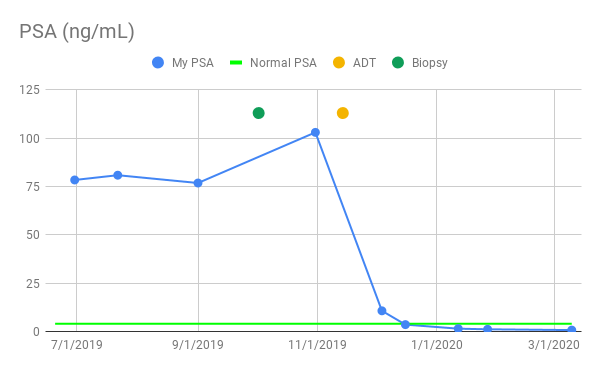
My PSA score is still dropping after four months of hormone therapy. As of this week it has plummeted to .74 which is well within the normal range for PSA screening. Next week my radical prostatectomy, if successful, should bring that number even lower – ideally to undetectable levels.
I’ve been asked several times over the last few days if I am ready.
When surgery was first proposed immediately following my diagnosis my answer would have been a resounding, “Hell no!” Since then I’ve learned a lot and have had the chance to talk to a lot of people. My favorite advice, which I have taken to heart, was to train for surgery like a runner does a marathon.
“If you train well enough you will succeed.”, I was told.
Today, aside from having cancer, I’m probably the healthiest I have been in my entire life. I’ve been exercising daily, eating healthy, and reigning in my stress and anxiety. Does that make me ready? I don’t know about ready, but I am prepared as I’ll ever be. Fire the starting pistol and let’s get this thing started already….
Take care. Stay healthy. Live life.
-Scott
Previous : Full Of …
Next : Surgery(s)
#prostatecancer #cancer #prostatitis #psa #prostate #urology #oncology #radicalprostatectomy #chemotherapy #hormonetherapy #surgery #lupron #leuprolide #firmagon #degarelix #docetaxel #drawnandcoded #iwillbeatthis
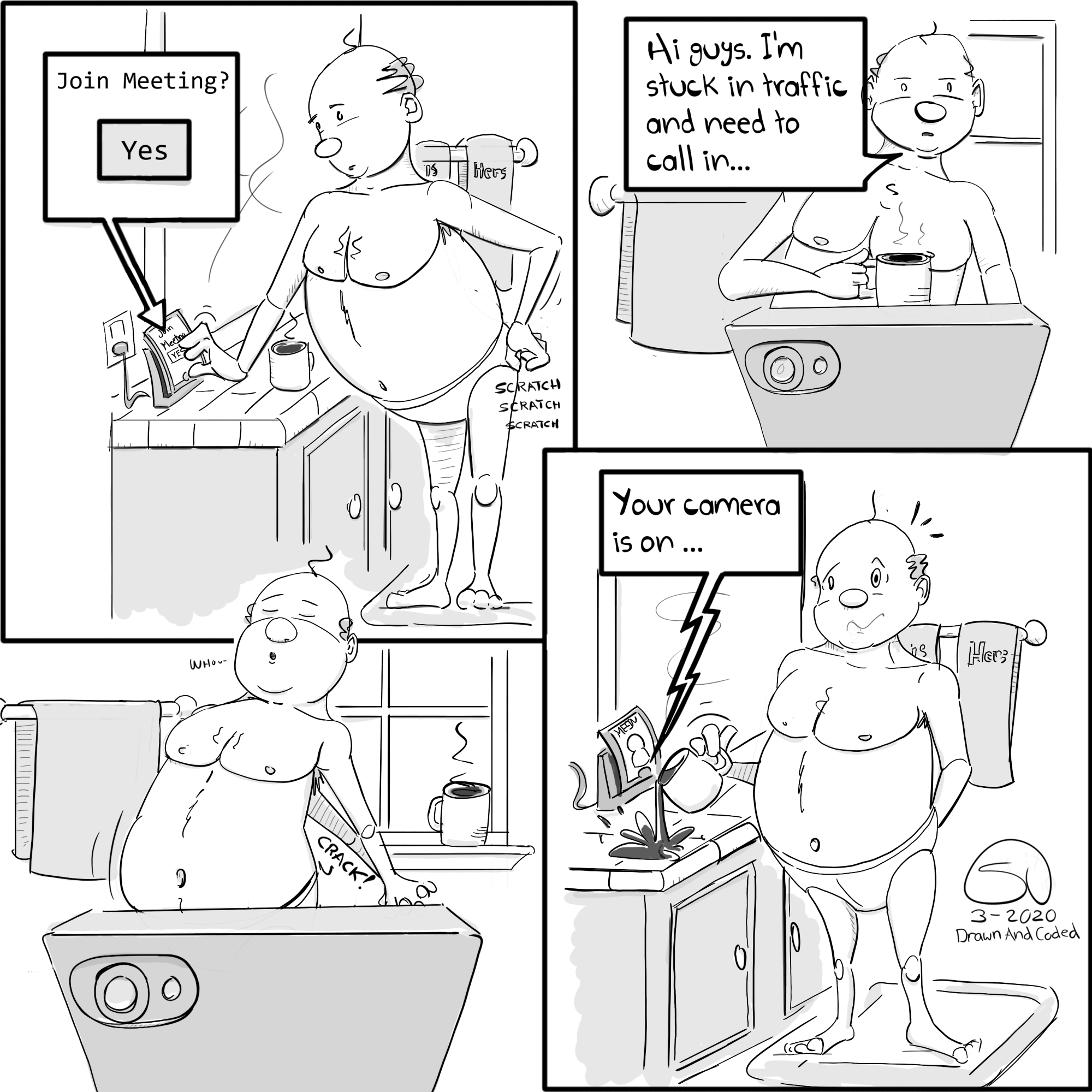
#conferencecalls #meetings #traffic #gridlock #whitelies #workhumor #officehumor #officelife #drawnandcoded #comic
“Jodie, what the heck does this mean?”, I grumbled.
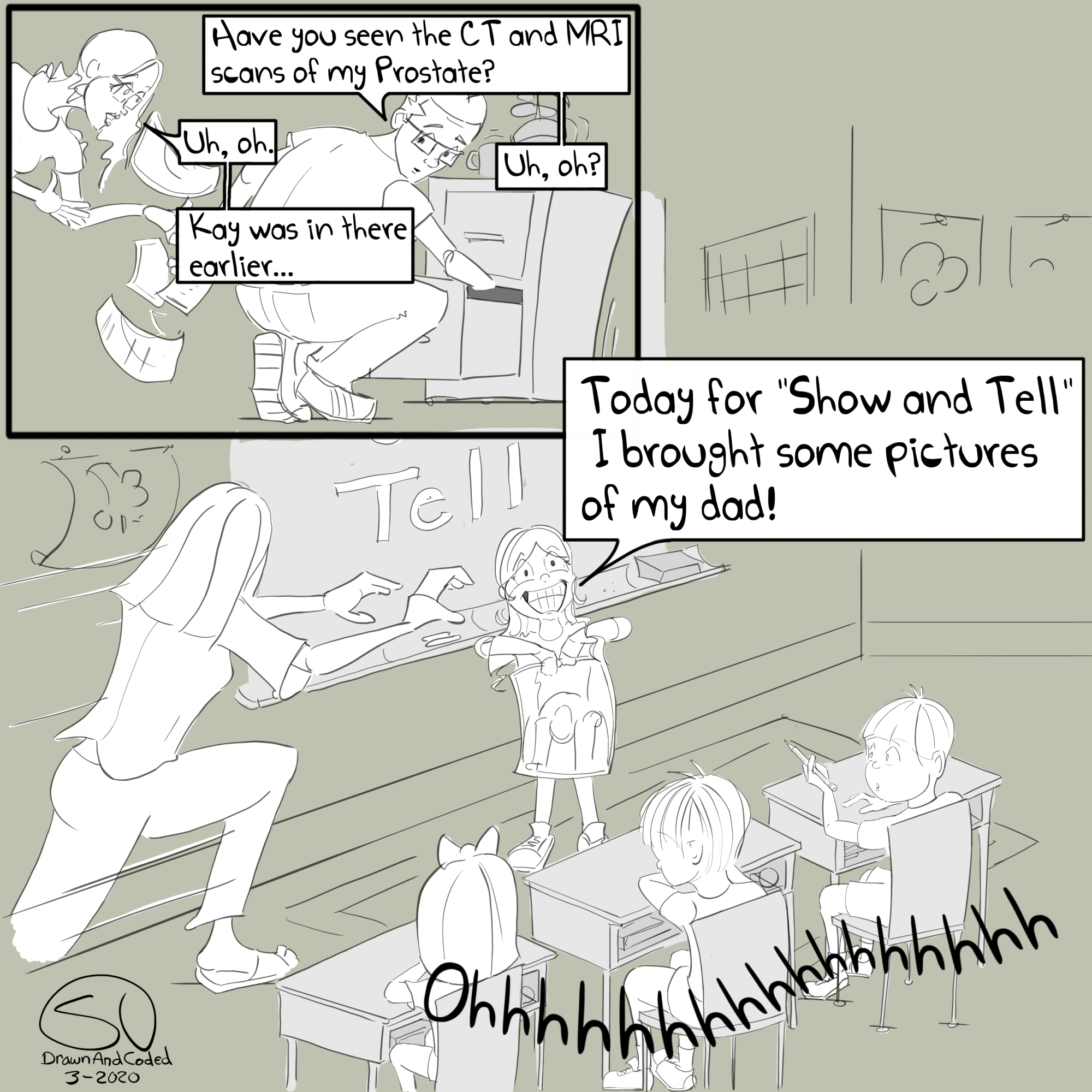
Jodie peered over my shoulder at the report for the CT scan that was performed on me two weeks prior. The report indicated, as my surgeon Dr. Kane had told us during my last appointment, that my prostate and compromised lymph node were now normal-sized. However, a little further down it read this :
Significant stool burden throughout the entire colon, indicating severe constipation.
SMALL & LARGE BOWEL: Significant stool burden throughout the colon.
“I think it means you were full of food.”, she replied.
“Well, YES. I mean, they had me fast for four hours ahead of time, so I crammed as much food in as I could.”
Jodie shrugged.
“And I am NOT constipated!”, I said with, in retrospect, a little too much bravado. I fired a quick email off to Dr. Stewart pleading my case and forgot all about it.
Fast forward a week.
Jodie and I were, once again, waiting in an exam room at UCSD’s Koman Outpatient Facility. We didn’t have to wait long before Dr. Stewart burst through the door.
“Oh my God, are you okay ?!?”
“Huh? What? Yeah, I’m fine, wh…”, I stuttered.
“I read your CT scan report and it sounds like you were very full and constipa ( smirking ) ….”
Dr. Stewart couldn’t keep it together and started laughing. In a prior post I wrote about doctors having to walk a fine line when using humor with their patients. Dr. Stewart nailed it this time. Jodie and I started laughing with him.
“Radiologists often point out things like this. I’ve looked at your scans and everything looks normal to me.”, he reassured me.
“Can you at least see what I ate in the scans?”, I asked, half jokingly.
Chuckling, Dr. Stewart brought up my scans on his computer and, although I thought they were as indecipherable as a rorschach test, he did his best to show me my full stomach and colon.
“So, how are you doing?”, he asked.
“Well, I’ve been on Lupron and Zytiga for over three months now.”, I told him, “The hot flashes are getting better, but I feel like I have had a lot less energy.”
“That’s because when you first started therapy it was a new challenge, but now that you’re in the thick of it, the honeymoon period is ov…..”, Dr. Stewart started.
“I’d hardly call it a honeymoon!”, I interrupted, smiling.
“Good point.”, Dr. Stewart chuckled, “Anything else?”
“Well, I got the paperwork for my radical prostatectomy next month, and I am a little relieved that I do not have to do an enema.”, I replied. In my opinion, food goes in the mouth and comes out the bottom, the reverse is never a good thing.
“Let’s talk about your surgery”, Dr. Stewart said.
He then told me that I would remain on Lupron during surgery, but I would take a two week break from Zytiga. When I asked him why, he told me that there’s not a lot of precedent for men being on Zytiga while having a radical prostatectomy. I would, however, remain on Prednisone the entire time. A week after surgery, the same day that I was to get my catheter removed, I would get my second shot of Lupron. I briefly envisioned how that day would go, and quickly changed channels. One step at a time, right?
“After surgery should my PSA be zero?”, I asked. PSA measures prostate inflammation. No prostate, no PSA.
“Yes.”, said Dr. Stewart.
“And if it’s not?”
Dr. Stewart started talking about radiation and I stopped him.
“For now, let’s just assume that the surgery is going to work and everything is going to be okay. I really don’t want to talk about radiation when I won’t really know if the surgery worked until I’m off of hormone therapy.”, I interrupted.
Hormone therapy starves prostate cancer cells. It’s why my PSA has dropped from 103 to 1.14 while I have been on it. As I am to remain on hormone therapy for up to two years, worrying about any residual cancer after surgery seemed premature.
Next, we discussed my genetic screening results.
Since being treated by Dr. Stewart I have had two genetic screening tests performed, the first by Tempus and the second by Invitae . These tests scan for BRCA1, BRCA2, and HOXB13 mutations in your DNA. While having these mutations greatly increase your chance of getting Breast, Ovarian, or Prostate Cancer, the mutations, being as common as they are, have been targeted by pharmaceutical companies in the development of newer, very effective medications, such as Lynparza.
Given my family history of cancer, Dr. Stewart thought that I might have had one of these mutations, but the results from both companies came back negative.
“Is that good or bad?”, I asked him.
“It’s neither good nor bad. It is what it is.”, Dr. Stewart replied.
I was almost disappointed. Having a known mutation would have likely made me an easier target for therapies. But then Jodie snapped me out of it.
“It’s good! It means that our daughters aren’t carriers, either.”, she said.
Thanks, honey. Very good point.
“Any other questions?”, Dr. Stewart asked.
I shook my head no which, in reality, was far from the truth. I had lots of questions, but realizing that not all of them had answers and that our appointment was winding down, I relented.
As it turns out I won’t see Dr. Stewart again for over two-and-a-half months. He explained that, after surgery, my cancer treatments will quickly become a routine of hormone therapy, bloodwork, and PSA tests for the next year or so. I understood, but I will miss our monthly pow-wows nonetheless. Dr. Stewart is a fantastic doctor. As he left the room I held up my arms in a mock embrace and smiled. He smiled back and closed the door behind him.
Take care. Stay healthy. Live life.
-Scott
Previous : Inspiration from above
Next : Let’s do this thing

#prostatecancer #cancer #prostatitis #psa #prostate #urology #oncology #radicalprostatectomy #chemotherapy #hormonetherapy #surgery #lupron #leuprolide #firmagon #degarelix #docetaxel #drawnandcoded #iwillbeatthis

#valentines #happyvalentinesday #valentinesday #handmade #handcrafted #parenting #family #parentingfail #drawnandcoded #sketchbook #comic #funny
“You have cancer.”
Initially, I didn’t handle the news too well. I reached out and sobbed to my family and friends. I dismissed work and contemplated quitting. I checked and rechecked my life insurance policy and my will.
So much for staying calm.
After about two weeks of freaking out my friends, my family, and myself, I woke up one morning, looked at the sunrise from my bedroom window, and realized that I was still very much alive. Death, apparently, had better things to do. I realized that I did, too.
I started by making my bed.
Later that day, while at work, I searched on YouTube for “Inspiring Cancer Stories”. I arbitrarily clicked on a link to a speech by Jen Sotham, a writer and musician who lived in New York with Stage 4 Melanoma. Her entire speech was fantastic, however at 12 minutes and 15 seconds she summed it up for me in one sentence.
She said, “This disease might kill me, but you will never ever catch me dying.”
That hit home.
Yes, cancer is serious. Yes, if it’s not cured it’s terminal. But life is terminal. Rather than live each day hanging by a thread, I decided that I’d rather swing from it instead.
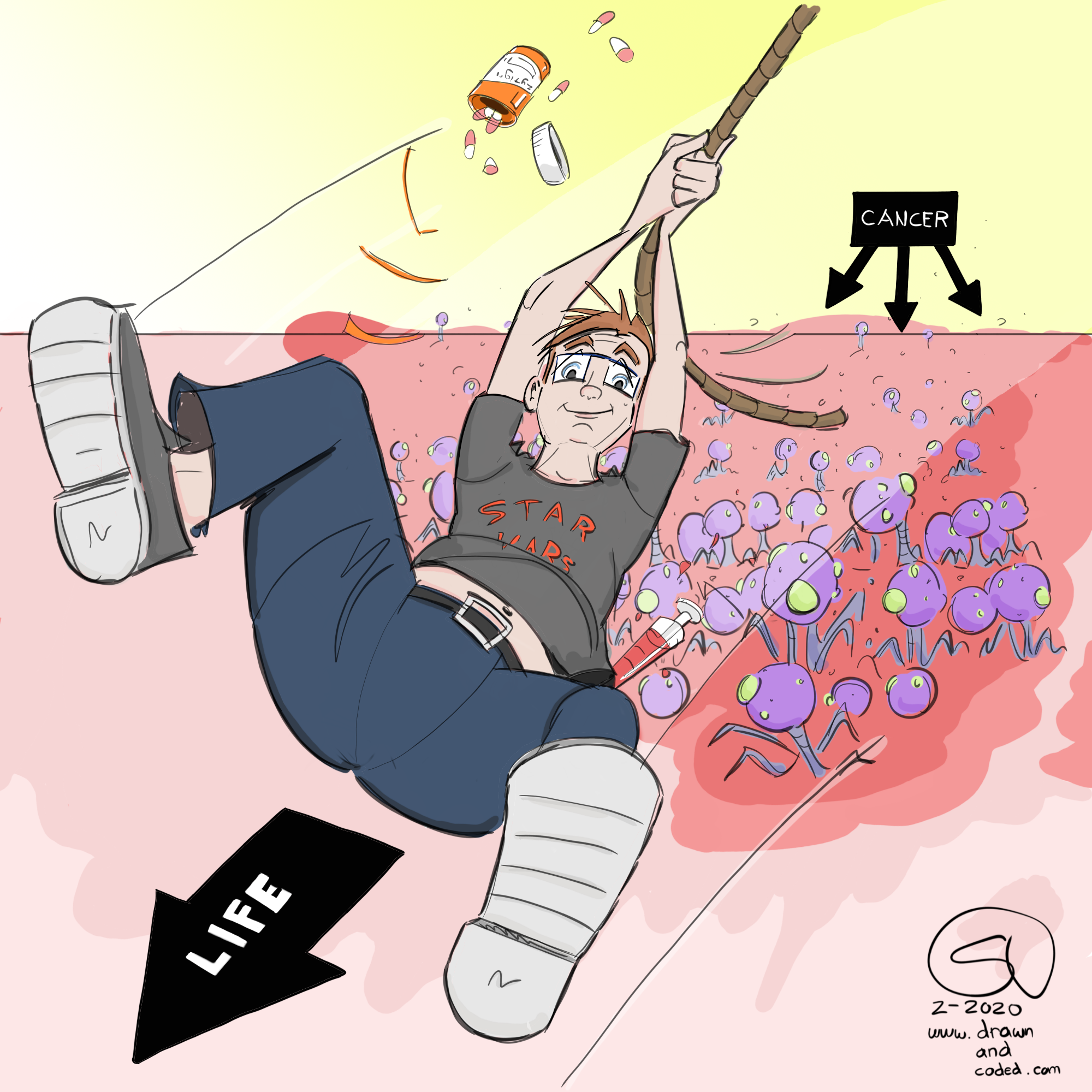
As it turns out, psychological health has a dramatic effect on cancer. There are over 1,000 completed or in progress clinical studies that have investigated this relationship. Stress and anxiety can arguably increase your risk of cancer, or encourage it to metastasize. As cancer inevitably causes stress, and stress, cancer, I quickly realized that I needed to do something to stop the vicious circle.



Over the last year, with the help of my friends, family, doctors, therapists, and a whole bunch of books I have compiled a list of strategies, or coping mechanisms which have made living with cancer easier for me. Now, I would like to share these with you…
We’ve been having family movie night at the Vandervort household lately. It typically starts with Jodie or I selecting a favorite from our youth, presenting it to the kids, getting shot down with scathing remarks, and then, finally, forcing them to watch it anyway else they lose their electronic devices. So, over the holidays we watched “The Sound of Music”. During the first half of the movie, Julie Andrews sings a song to the Von Trapp children to help cheer them up during a thunderstorm. The song is called “My Favorite Things”, and it lists several things that Julie’s character, Maria, thinks of when she is feeling scared or sad. Even if you haven’t seen the movie, you’ve probably heard the song. Our kids loved the scene and promptly fell asleep after it ended.
The following morning Jodie and I were awoken by Julie Andrews belting out “My Favorite Things” on our downstairs Google Home. Instead of making me angry, the song brought a smile to my face.
What I’ve realized is that, when dealing with cancer, what makes me happy isn’t always obvious. I tend to lose sight of it amidst all of the chaos going on. Now, like Maria, I keep a list to remind me. When I’m feeling down, or scared, or depressed I look at my list, pick something off of it to do, and generally, it cheers me up.

This year for our New Year’s resolution Jodie and I both decided to reduce the amount of time we spend on our mobile phones, particularly at dinner time. We both realized that it was not only distracting, but a bad influence on the kids. Now we holster our phones at dinner and try to be in the moment.
When dealing with cancer my mind is anything but in the moment. I find myself constantly worrying about the future, scrutinizing the past for answers, or just letting my mind wander aimlessly.
To help me stay in the moment I do four things :
My wife, Jodie, and I talk about cancer a lot these days. One night, not so long ago, after tucking the kids in, I made the recurring mistake of looking at survival statistics on my mobile phone while getting ready for bed.
“Sigh….”
“What?”, Jodie asked me.
“Nothing….”, I replied.
“SIGH.”
“WHAT!?!”, Jodie asked me again, a little more annoyed.
“I made the mistake of looking up survival statistics for late stage prostate cancer on the web again. It’s not pretty.”, I admitted.
After glancing over my shoulder Jodie said, “We’ve talked about this before. Statistics are just an average based on a wide variety of people and ages.”
She took the phone from my hand and continued, “Not everyone has access to good health care, either. And, a lot of people don’t take care of themselves. You exercise, watch your diet, and you are doing great at keeping your stress under control. You are also much younger than the typical prostate cancer patient”
“Good point, honey. My doctors are top-notch, too. And, the statistics are probably based upon old data.”, I responded.
“Exactly! One of your doctors even said that by the time those statistics are published they are ten years out of date.”, she said.
“10 years is a long time considering the rapid pace of cancer research”, I agreed.
“Yes! So stop looking at the statistics!”, she demanded, with the hint of a smile.
Reassured, I was able to sleep well that night and learned three valuable things :
Within a day after my diagnosis I received a phone call from Pat Sheffler, another dad in my neighborhood who had been diagnosed with prostate cancer a year-and-a-half earlier. Later that evening I got another call from David Ederer, a family friend who had been successfully battling prostate cancer for over 20 years. I spent over two hours on the phone that day talking to two complete strangers who only wanted to help me. I’ve been in contact with both men ever since.
I’ve heard prostate cancer referred to as “the club that no one wants to join”. It’s true, no one wants cancer, but the amount of unsolicited support that I’ve gotten has been nothing short of amazing.
For me, joining the club meant embracing the disease, admitting that I need help, and talking openly to others. Membership has reassured me that I’m not alone, that I’m not trailblazing a new path, and that people just want to help. It’s also inspired me to help others with their fight as well.
Cancer is a loss of control. It’s my own cells recklessly growing and dividing. It’s side effects from treatments. It’s plans and vacations put on hold. It’s not knowing “why”.
The loss of control is frustrating, but part of the healing process, at least for me, was to acknowledge it and move on. And, after accepting a loss of control, I was determined to take control of what I could. I didn’t want to be just a helpless passenger on my road of treatment, I wanted to be an active participant.
What I realized is that although a doctor can prescribe medication, surgery, and chemotherapy, they can only suggest lifestyle changes. Lifestyle changes such as diet and exercise were two things that were entirely up to me. They were two things that I could take control of in my cancer treatment.
As I’ve always been pretty good about exercising, I decided to focus on diet instead. Fortunately, my wife, Jodie, already had a head start after reading “How Not to Die” by Dr. Michael Greger. Since taking control, my wife and I have spent countless hours researching what I should and should not be eating. In a sense we decided that I would perform my own “chemotherapy”, but instead of injecting my body with harsh chemicals, I would nurture it instead with cancer-fighting food.
Does it make a difference? I think it does. The number of research studies on nutrition and cancer seem to indicate that it makes a difference, too. Regardless if it does or not, the act of taking control of one facet of my treatment has made me feel a whole lot better.
“I’m not done yet.”
These four words are incredibly important.
If you have things to do, it gives you a reason to live. If you have a reason to live, you have one less reason to die. I have lots of things to do, and each day I have more.
Long term goals help me visualize myself alive and healthy in the future. Cancer, I believe, hates this, so I try and set my long-term goals as far out in the future as possible just to rattle its chain. My daughters graduation? Yup, I’ll be there. Walk them down the aisle? Of course. That family vacation to Hawaii we’ve been trying to do? Of course I’ll be there; let’s go snorkeling, too.
Short term goals keep me focused or, more accurately, distracted from all of the cancer sh*t that is going on. Completing a short term goal yields a sense of accomplishment, or a burst of positivity, too. I feel that cancer abhors the positive so I try to set lots and lots of short-term goals. My first goal every morning, as it has been for a while now, is to make my bed. From there my goals obviously get more complicated, but every time I finish one I feel just a little better.
So, go away cancer, I have work to do. I’m not done yet. I have goals.
It’s the voice of reason and sympathy and it’s incredibly easy to ignore, especially when you are angry, in pain, or frustrated.
It’s the voice that keeps your middle finger from standing to attention when someone cuts you off in traffic. It’s the voice that rationalizes that lingering hip pain is more likely due to a bad night’s sleep than cancer. It’s the voice that urges you to get up and take a walk when you’ve been struggling with something at work for too long.
Since I started listening to my inner voice it had saved me from a whole lot of grief. I really wish I started listening to it sooner.
I get anxious when my mind is disorganized. When my mind is disorganized I find myself thinking about the same things over and over again to ad nauseum. Unfortunately, nothing has cluttered my mind more than cancer. The sheer amount of information that I have had to absorb from my doctors appointments alone has brought my mind to a screeching halt at times.
Fortunately, I’ve found that keeping a journal helps.
By keeping a journal I can write my thoughts down and spend time organizing them and validating their credibility. Later, when the same thought inevitably pops up again, I can consult my journal, and more easily dismiss things.
A calm mind is essential when dealing with diseases such as cancer. I realized this after being prescribed physical therapy to help with the pain caused by, what my doctors thought at the time, was Prostatitis. Every session my therapist would throw more “exercises” at me. By my sixth session I was stretching and breathing for up to 45 minutes a night. And you know what? It worked! My pain greatly diminished. Later I would realize that what I was essentially doing was yoga and meditation.

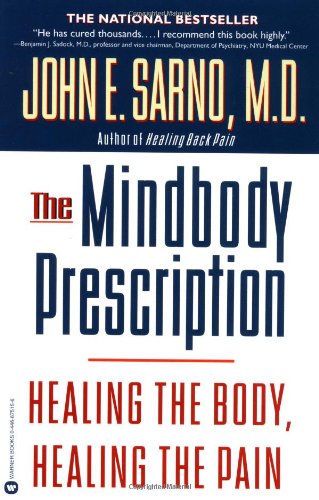
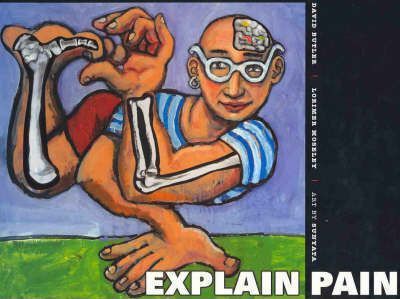
After reading “Explain Pain” by David Butler and “The Mindbody Prescription” by John E. Sarno I began to understand importance of maintaining a calm mind better. I learned that the opposite of a calm mind is an anxious mind. An anxious mind causes tension; think grinding teeth, clenching fists, and upset stomachs. This tension, over time, causes pain. And pain, in turn, causes even more anxiety. It’s a vicious cycle that builds and builds upon itself and, after understanding how it worked, I could finally work on breaking the cycle.
Yoga and Meditation were a good start, but pain isn’t always caused by anxiety. Pain can also be the result of disease or an injury. If you’re lucky a doctor can identify the causation, patch you up, and send you on your way. However, sometimes the path to health isn’t always a straight line.
That’s where prayer helps.
Early on, when I was suffering through Prostatitis, I read “How to Stop Worrying and Start Living” by Dale Carnegie. In it he suggested prayer to help alleviate stress and anxiety. God, he suggested, can help shoulder burdens that can’t be shared with anyone else. I filed Mr. Carnegie’s advice in the back of my mind, but being agnostic, I didn’t take it to heart for several more months. It was only later, after I started coming home from work in pain-induced panic attacks and relying on prescription drugs to help me sleep that, in desperation, I revisited his advice and started praying.

Prayer has helped me tremendously, particularly after I was diagnosed with Prostate Cancer. Regardless of who or what you believe in – whether it be God, Allah, the Buddah, or the Great Spaghetti Monster in the Sky, it really helps to have someone to talk to about things that can’t be said, to ask questions of that can’t be answered, to ask favors of that can’t be granted, and most importantly, to have faith in, and trust that, in the end, everything is going to be okay.
Stay healthy.
Live life.
Till next time.
– Scott
Previous : Surgery is over a month away, today is now
Next : Inspiration from above
#prostatecancer #cancer #prostatitis #psa #prostate #urology #oncology #radicalprostatectomy #chemotherapy #hormonetherapy #surgery #lupron #leuprolide #firmagon #degarelix #docetaxel #drawnandcoded #iwillbeatthis

#amazon #wholefoods #amazonfresh #grocerydelivery #buyitnow #fresh #foodie #grocerystore #hungry #hangry #comics #drawnandcoded #sketchbook

#handyman #homeimprovement #diy #handymanservices #construction #painting #contractor #carpentry #renovation #tools #homerepair #interiordesign #maintenance #plumbing #plumber #homerenovation #carpenter #woodworking #electrician #paint #propertymaintenance #realestate #remodel #electrician #repairman #drywaller #drywall #weekendwarrior #doityourself #comic #drawnandcoded

#nostalgia #OldFashionedChristmas #ChristmasComic #Fireplace #ChristmasTreeFail #Christmas #ParentingFail #parenting #kids #RaisingKids #family #drawnandcoded #comic

Previous : Let food be thy medicine …
Next : The plan, for now …

#prostatecancer #cancer #prostatitis #psa #prostate #urology #oncology #drawnandcoded #iwillbeatthis #comics #radiology #mri #radiologist #researchstudy #clincialstudy

