Treatment Options

The big question when it comes to cancer – any cancer is if and where the cancer has spread. Localized cancer and metastasized cancer are treated very differently. As treatments are inevitably harsh on the patients’ body, a doctor wants to make sure that the treatment fits the disease. For me that meant more blood work, another CT Scan, this time of my chest, and an MRI Scan. Although I was also supposed to get either a PSMA or Axumin Scan done as well, availability and insurance approval has pushed those out to a later date. 

I covered the blood work as well as CT Scans in prior posts so I’ll skip the details. MRI Scans, however, are uncharted territory and deserve some attention.

Dr. Stewart wanted an MRI Scan performed on my groin to get a better look at my prostate and nearby lymph nodes. I asked him what was wrong with the CT Scan that I had performed just a few weeks prior and was told that an MRI Scan produces more detailed images. MRI stands for “Magnetic resonance imaging”. An MRI uses a strong magnetic field to manipulate the atoms in your body. Radio waves are then used to create an image of the excited atoms. Fortunately, MRI Scans do not use radiation so they are relatively safe.

Another interesting factoid : Chemotherapy and recent tattoos (within 30 days) are a no-no for MRI. While talking to the MRI receptionist I found out that the electromagnets heat up the ink and/or chemicals. Naturally, pacemakers and any metal objects make you ineligible as well. I’m so glad I didn’t get that tattoo on my ass that says, “F*ck Cancer”. 

Prior to my procedure the MRI technician guided me to the bathroom and in broken English advised me that, “Clean balls will help the machine produce a better image.” She then turned and walked away leaving my wife and I to ponder the logistics of such a task given that the bathroom had no shower. We eventually decided that the technician actually said “clean bowels”. After complying I met the technician in the MRI room. 

MRI Prostate Cancer
My wife always managed to make me smile, even when waiting for an MRI.

So what’s an MRI like? If you’re slim and not claustrophobic an MRI is relatively uneventful. If the opposite is true, then God help you.

You literally lie perfectly still in a long narrow tube for about an hour with your nose mere inches from the ceiling. It would be peaceful if it weren’t for the constant loud hum and banging of the machine’s electromagnets toggling on and off.

MRI UCSD Prostate Cancer
Let the loud “thunking” noises commence!

Let’s take a step back for a moment to tally up everything. So far I’ve had :

2 CT Scans.

1 MRI.

4 PSA Tests.

2 Ultrasounds.

1 Genetic screening of my blood and biopsy.

1 Bacterial analysis of my semen.

1 Prostate Biopsy.

3 Digital Rectal Exams (DRE).

8 Prescriptions; 4 of which were for Antibiotics

30 Appointments with Doctors and Therapists.

That is a lot of information for an organ that started off the size of a walnut. Given all that information I’ve realized one important thing and that is :

You should always procure copies of your medical records including any procedures or scans that you have had done. 

For prostate cancer, and I assume any type of chronic disease you will likely want to consult with doctors across different networks. Every single one of those doctors will want to see these records. The problem is hospitals are terrible at sharing. This is done to protect you, the patient. HIPPA, or “Health Insurance Portability and Accountability” Act of 2003 made the process a lot easier but 16 years later, hospitals are still struggling to upgrade their systems to adhere to the new regulations. Record transfers between networks typically require a faxed ( yes, fax ) request. 

The images produced by CT, MRI, and Bone Scans are even more cumbersome. 

In software development we have a term called “Sneaker Net”. Prior to the internet and networked computers the only way to copy a file from one computer to another was to put the file on a disk and physically walk the disk between the computers. Although hospitals are digitizing their records, they are doing it at a glacial pace. While some records can be emailed, images produced by scans must be copied to a CD. This CD must then be walked, or “Sneaker Net”’ to the requesting hospital. I spent two hours on Wednesday doing exactly this to get my original CT and Bone Scans from Scripps to UCSD.

On Thursdays UCSD has their “Tumor Board” where Dr. Stewart presented my case to 15 urologists, oncologists, and surgeons to brainstorm how to treat my cancer. 

Following the dismissal of the board I met with Dr. Stewart to go over the treatment options they had discussed.  My mom and my wife, Jodie joined me in an hour-and-a-half discussion.

First the good news. The CT Scan of my chest came back clear. There was no evidence of the cancer metastasizing there. In addition, the MRI scan showed my prostate and enlarged lymph node pretty much unchanged since my first CT scan from a few weeks ago.

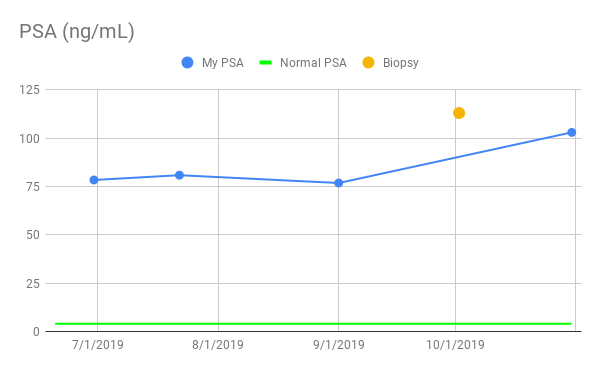
Now the not so good news. My prostate and lymph node were still teeming with prostate cancer. Furthermore, my blood test indicated that my PSA was climbing. Prior to my biopsy it had been in the high 70’s. Now it was 103.  Dr. Stewart told me that due to my young age, the aggressiveness of my cancer, and my high PSA that my situation did not fit the typical treatment protocol. He wanted to think “outside of the box” and be very aggressive with my treatment. In short, the “Tumor Board” couldn’t make a unanimous decision. Instead, they came up with three treatment options :

  1. Radiation treatment plus two years of hormone therapy.
  2. Surgery followed by radiation treatment and hormone therapy.
  3. Two years of hormone therapy, six cycles of chemotherapy, and 6 months of radiation treatment.

You’ll notice that the only commonality between all three treatments is hormone therapy. Hormone therapy is used in conjunction with radiation, chemotherapy, and surgery. It’s complementary and doesn’t affect the administering of the other treatments. As such it was the main topic of discussion for our meeting and the first treatment that Dr. Stewart wanted to administer. 

Hormone therapy should really be called anti-hormone therapy as it is done to deprive the body of testosterone. 

As I mentioned in a prior post, testosterone feeds prostate cancer. By doing away with testosterone you can starve the prostate cancer cells – at least for a while. Here’s the rub – hormone therapy doesn’t work forever. Eventually prostate cancer cells gain the ability to produce their own testosterone, or are no longer dependent on it. Hormone therapy is also known as “androgen deprivation therapy, or ADT. 

The side effects of hormone therapy are the same as if you were castrated.  It is also referred to as “chemical castration”.

In fact, the alternative to hormone therapy is the removal of the tesicles which is known as an “orchiectomy”. Fortunately, this is seldom done anymore but that didn’t stop Jodie and I from joking about the potential upside of prosthetics. 

“Would you go larger, say the male equivalent of a DD bra?”, I joked.

“Or, would you go smaller to make everything else look larger?”, Jodie retorted.

Fortunately, Dr. Stewart and my mom had a good sense of humor throughout this discussion. 

Now for the side effects. They include fatigue, muscle loss, weight gain, osteoporosis, libido, mood swings, breast tenderness, and hot flashes. I joked with Jodie that if I could of delayed my cancer for another 15 years that we could of gone through menopause together.

Yeah, so the side effects suck. It sounds like weight lifting as well as increasing my vitamin intake will help. Given that the treatment is to be administered over two years well, it’s going to be a long two years. 

Lupron is the most common medication administered for ADT. It is administered as a shot every three months. However, given that my PSA is rising Dr. Stewart decided to put me on a different medication called Degarelix, also known as (ahem) Firmagon. Dr. Stewart chuckled at this and we caught on immediately.  

“You’ve got to be kidding me. Who names a drug that saps your testosterone FIRMagon?”, I asked. “Someone in marketing has a sick sense of humor.”

Dr. Stewart didn’t really have much of an answer but explained that Flacidagon, unlike Lupron does not cause your testosterone levels to temporarily spike and would have a better chance of keeping my cancer in check.

It was then that Dr. Stewart told us that testosterone, in addition to being produced by the testicles is also produced by the adrenal glands. As such he also wanted to prescribe me another medication called Zytiga. Up until this point I had not asked about the cost of all of the medications but Zytiga rang a bell. I vaguely remembered coming across it while browsing the web.

“Um. So, how much does Zytiga cost?”, I asked.

When Dr. Stewart deflected by talking about insurance approval and financial assistance I knew that I had struck a chord. He eventually told me that if I had to pay more than $50 per month that I could probably work something out with financial assistance. Naturally my curiosity got the better of me. After our appointment I consulted Google and realized that Zytiga costs ( ready for this? ) roughly $10,000 per month.

Ouch.

Zytiga, in addition to draining the pocketbook can also affect your heart and liver. Dr. Stewart told me that while I was taking it I would need to have frequent blood screenings and monitor my blood pressure daily. 

It’s going to be a long two years.

Even though there has been no evidence thus far of my cancer metastasizing outside my pelvic region I get the feeling that Dr. Stuart nor the “Tumor Board” are convinced. The deciding factor I believe, rests on the outcome of my pending PSMA or Axumin Scan. What’s the holdup? Well, the PSMA machine can only be performed at UCLA and is booked up for over a month. And then of course, there’s the approval required by my insurance company.

It’s inevitable that insurance would eventually come up in a discussion over cancer. 

Cancer treatments are expensive. Because of this, I’ve realized that every medication and procedure needs explicit approval from my insurance company. Unfortunately, the approval process takes roughly three days. If an approval is requested on say, a three day weekend you’re looking at a significantly longer delay. When dealing with cancer there is a sense of unnerving urgency, too, like you’re half expecting an alien to burst through your stomach if you delay too long. 

Fortunately, I have my wife, Jodie.

As soon as she realized that insurance was holding up my treatment she was on the phone with them. She doesn’t take no for an answer, either.  Hopefully early next week I will get my first injection of hormone therapy and I will finally begin the initial stage of my treatment.

Take care. Stay healthy. Live life.

-Scott

Previous : Building My Team

Next : Drug Interactions

PSA Prostate Cancer
My PSA ( ng/mL ) as of 10/31/2019

#prostatecancer #cancer #prostatitis #psa #prostate #urology #oncology #drawnandcoded #iwillbeatthis
A Second Opinion

Yesterday, while most of LA was trying to escape a fire that had broken out along the 405 near the Getty Museum my wife, Jodie and I raced towards it. I had an appointment with Dr. Stuart Holden, a urological oncologist at UCLA that had been recommended to me by a family friend.

I can best describe the UCLA Medicine complex as what would happen if a hospital building devoured several other hospital buildings and then plopped itself down in the middle of a bustling downtown. The size was bewildering! While checking in at Urology Jodie noticed that all of the doctors’ cards were arranged on a turnstile like the ones grocery stores use to display gift cards. We counted over 30 before finding and pocketing Dr. Holdens. 

It’s amazing how different doctors can have such dramatically different opinions on treatment.

Last week I talked to Dr. Carrie Costantini, an oncologist at Scripps. She gave me two options, either remove my prostate, or bombard it with radiation. Dr. Holden told me that performing surgery was premature without first determining if the cancer had spread. He said that the treatment varies considerably depending on whether or not the cancer is contained within the prostate or has spread elsewhere. Furthermore, performing surgery or treatment before getting a full picture might make me ineligible for clinical trials. 

Dr. Holden told me that out of the 60 urologists in his office that none of them would preemptively operate without running additional tests. 

These tests include a bleeding edge scan called a Ga-PSMA PET CT Scan. What a mouthful, right? In my last post I wrote about the Prostate-specific antigen ( PSA ) test for helping to detect prostate cancer. To clarify, PSA is a protein produced by the prostate. When the prostate is inflamed it produces more of it. Thus, it is commonly used as an indicator of cancer. As it turns out once prostate cancer has metastasized the PSA protein is not as accurate, particularly with aggressive cancer such as yours truly has. The Prostate-specific membrane antigen ( PSMA ) is another protein that’s prevalent in metastasized prostate cancer cells. This new PSMA scan can pinpoint exactly where prostate cancer has metastasized so that targeted drugs can be delivered. Or, at least that’s what Dr. Holden is trying to sell me on. The truth is? I believe him. The downside is that the test costs just shy of $3000, is not ( yet ) FDA approved, and I’ll have to drive UCLA to get it done. Hopefully the fires will have been extinguished by then.

Dr. Holden also wanted me to get a genetic screening done as he suspects my cancer is likely well, genetic. Whereas Scripps told me there was a 4 month lead time, Dr. Holden directed me to a company called Color Genomics. For $249 and some of your spit Color Genomics will determine if you have any known cancer genes including BRCA-1 and BRCA-2. BRCA stands for “BReast CAncer susceptibility gene”. Dr. Holden told me that my cancer treatment could vary based upon the findings produced by the genetic screening. Having the genetic screening performed will also help determine if my daughters might be at risk of cancer someday as well.

Lastly, Dr. Holden was perplexed why my initial CT Scan did not include my entire body. He told me that given my high PSA ( 78+ ) and Gleason ( 8-10 ) scores that it would be highly unlikely that the cancer would not have already metastasized. He told me that this warranted a CT Scan of my entire body – not just my groin area. He said that the CT Scan that I received was an impartial picture of the problem. Dr. Holden was just as perplexed why my prostate biopsy wasn’t guided by Magnetic Resonance Imaging ( MRI ). A urologist has the option of using an MRI machine to target specific regions of the prostate during a biopsy. My urologist removed 12 samples, or cores randomly from my prostate. In his defense however, he struck “gold” everywhere he dug. 

Then Dr. Holden gave me yet another Digital Rectal Exam.

I’m beginning to realize that Prostate Exams are to a urologist as handshakes are to everyone else. 

It’s just their way of saying, “Hi. Nice to meet you.” Fortunately, Dr. Holden admitted to having small hands before niceties were exchanged.

So what’s next? This Friday I have another second ( third? ) opinion with a Dr. Tyler Stewart a urological oncologist at UCSD’s Moores Cancer Society. After that I’ll have more than enough information to make an educated decision on what to do next. 

Not for the last time I am incredibly grateful for the outpouring of support from everyone as I work through all of this. I can’t thank you enough. I’m beginning to realize that cancer is a full-time job but at the same time it’s important not to lose sight of what is important. I love you all. Take care. Eat Healthy. Stay Healthy. 

Take care. Stay healthy. Live life.

-Scott

Previous : Prostate Cancer

Next : Building My Team

PSA Prostate Cancer
My PSA ( ng/mL ) as of 10/31/2019

#prostatecancer #cancer #prostatitis #psa #prostate #urology #oncology #drawnandcoded #iwillbeatthis

Prostate Cancer

After over 20 appointments with a variety of doctors and therapists it turns out my Prostatitis is in fact Prostate Cancer. 

Let’s rewind a little bit…

Back in May I started having some urinary issues. I was getting up several times a night to pee. I was having trouble starting and stopping. After I started peeing every half-hour I visited Urgent Care. The Urgent Care doctor diagnosed me with Prostatitis, a painful inflammation of the Prostate gland. A follow-up with two different urologists confirmed the diagnosis. Each urologist performed their own Digital Rectal Exam ( DRE ) and independently reported that I was sporting a “large squishy prostate with no noticeable tumors”. Sexy, right? My second urologist even went as far as to ( cough, cough ) “milk” my Prostate for bacterial analysis.

The rear end is the porthole to “everything prostate” and mine was well traveled at this point. 

Due to my age ( 43 ) and the negative DRE’s I was put through several rounds of antibiotics and physical therapy. I was given a Prostate-specific antigen ( PSA ) test to see if I was a candidate for a drug called Finasteride. Finasteride is one of several drugs that is used to shrink the prostate. It is given to men with enlarged prostates, or Benign Prostatic Hyperplasia ( BPH ) to help alleviate symptoms. A PSA test is a simple blood test that is typically performed on men over 50 to check for prostate inflammation. PSA tests are not usually administered to men suffering from Prostatitis as the inflammation can skew the numbers. A PSA under 2.5 is considered normal. Mine? 78.38. I’ve always been an overachiever.

After two more elevated PSA tests ( 80.85 and 76.81 ) and persistent pain my urologist decided that I should get a Prostate Biopsy. A Prostate Biopsy is a surgical procedure where a doctor goes through your rear end ( yes, again ) and take 6-12 “cores”, or samples from the prostate. A pathology report is then performed and a Gleason Score is attributed with each sample. The Gleason Score measures the aggressiveness of the cancer. All 12 of my samples came back with cancer. 11 of the 12 were in the 8’s and 9’s. The 12th came back as a 10. My urologist, wife, and I were all shocked.

Sometimes you win the wrong lottery. 

After a biopsy comes back positive for cancer the next thing a doctor does is prescribe scans to see if and where the cancer has spread. I spent the better part of a day with my wife, Jodie getting a Nuclear Bone Scan and a Computed Tomography ( CT ) Scan. A Nuclear Bone Scan is used to determine if the cancer has spread to your bones. It requires you to be injected with a small amount of radioactive material. After a couple of hours the material binds with the bones in your skeleton after which you are placed under a large machine resembling an automotive lift. The machine slowly moves down your body and detects where the radioactive material accumulated in your skeleton. A CT scan requires the injection of a “contrast” into your blood. This time you are placed in a large machine resembling an enormous toilet bowl. The machine takes a 3D image of your body and using the contrast, can determine if the cancer has spread to any nearby organs. After a radiologist reviews your scans you meet with an oncologist and for me, a surgeon.

Let’s fast forward to this week …

Over the last couple of days I met with a surgeon and an oncologist to go over my scans. The good news is that my cancer hasn’t spread to my bones or any distant organs. The bad news is that it has likely spread to a nearby lymph node. The oncologist that I met with couldn’t accurately stage me through the biopsy or scans but predicted that I would be a “high” Stage III or a Stage IV. The big differentiation is that a Stage III is curable whereas a Stage IV is treatable. 

The plan is to perform a Radical Prostatectomy, or the removal of my prostate and nearby lymph nodes on November 7th. The sole coolness factor is that the procedure is done robotically through two small incisions. The downsides are many. The recovery can take several months during which I will likely have incontinence, swelling, and libido issues. I imagine these are the some of the same issues a woman suffers after a C-Section without the benefit of a new baby at the end. Three months following my surgery another PSA test will be administered. If everything goes well my PSA test will be zero and I will just have to have regular tests administered to track any signs of cancer. However, if my PSA test is not zero it means that my cancer still persists and I will likely undergo radiation and hormone suppressing treatment. For good measure I am planning on getting two more second opinions from other oncologists prior to my surgery.

The cat’s out of the bag …

As of yesterday, my daughters, Ashley and Kaylee are aware of my Prostate Cancer. Their first question was obviously, “Are you going to die?”. I caught myself before responding, “…well, everyone does at some point” and told them firmly, “No. Absolutely not.” After a few more questions they happily went about their evening and promptly went across the street to the neighbors house to disseminate the news. At bedtime I read them a book my mom bought me called, “Cancer Party”. I can’t recommend this book enough for younger children. It takes a lighthearted informative approach to explaining everything cancer, radiation, and chemotherapy.

Healing foods…

In the meantime my wife, Jodie has taken it upon herself to help cure me through food. She’s read more books on healthy eating over the past few months than I can count. Together we have become superfood-eating pescatarians because God forbid we give up sushi. Our Frappuccinos have been replaced with green tea and our ice cream with dark chocolate. It would be a lot more traumatic if she weren’t such a good cook.

Moving forward I plan on posting regular updates on my progress here at DrawnAndCoded. I never ever intended this site to be used in such a manner but I am uncomfortable posting on normal social media channels such as Facebook.  My ultimate goal will be to keep everything as upbeat and informative as possible. And yes, there will still be comics and the occasional programming article as well.

Last but not least. Since my Prostate Cancer diagnoses I have received an overwhelming amount of support from my family, my friends, and complete strangers ( now, friends ). You know who you are. Thank you for your love and support. And please keep it coming. 

Take care. Stay healthy. Live life.

– Scott

Previous : Physical Therapy

Next : A Second Opinion

PSA Prostate Cancer
My PSA ( ng/mL ) as of 10/31/2019

#prostatecancer #cancer #prostatitis #psa #prostate #urology #oncology #drawnandcoded #iwillbeatthis

Physical Therapy

prostatitis prostate chronic pelvic pain syndrome cpps Ciprofloxacin Doxycycline bactrim tamsulosin chronic pain yoga physical therapy stretching comic

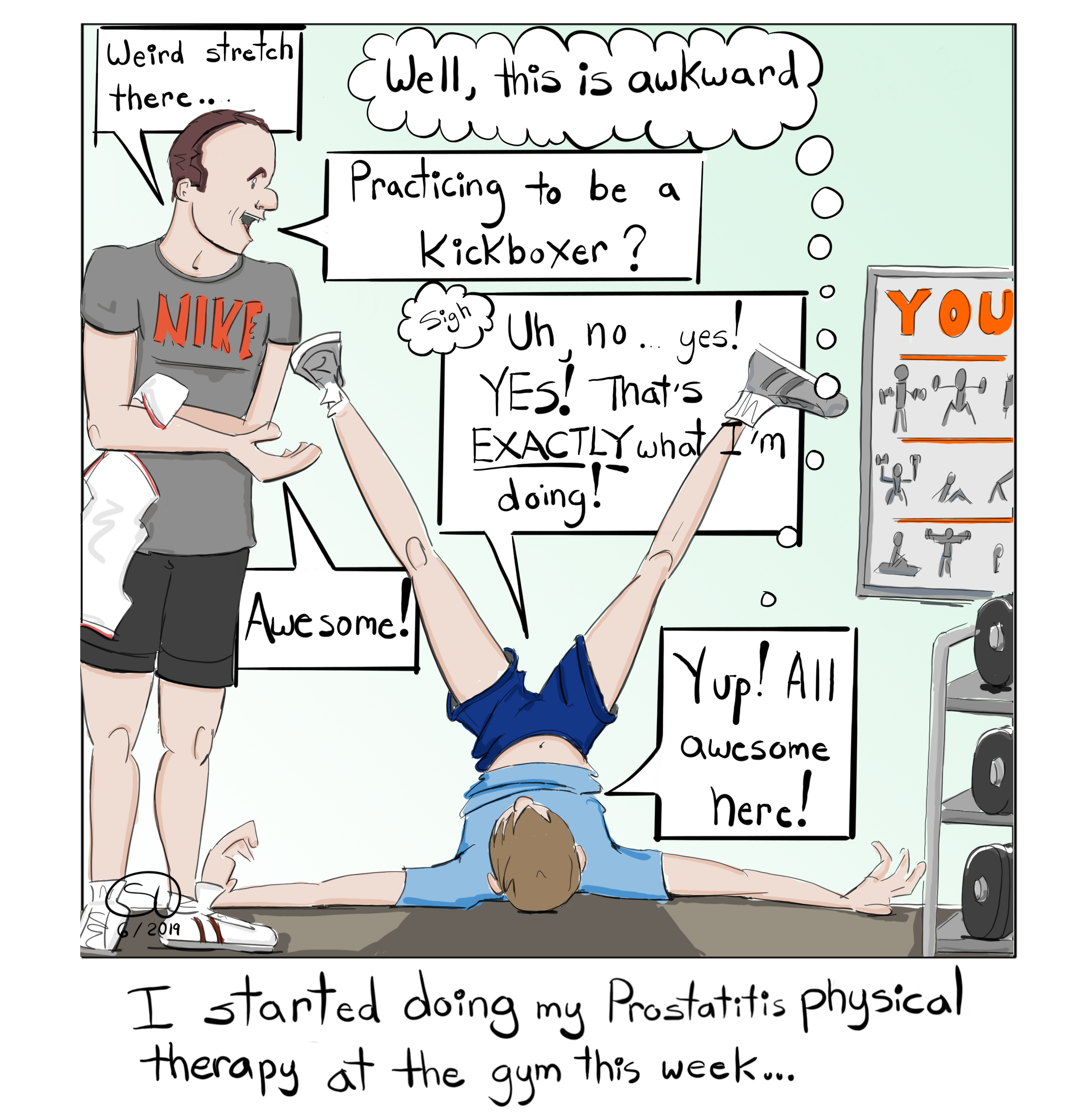
My urologist prescribed me physical therapy to help treat my Prostatitis symptoms. Thank you Jodi Tam of Renew Physical Therapy for making the pain so much more tolerable. The stretches you have prescribed are incredibly effective – if not socially awkward….

Take care. Stay healthy. Live life.

– Scott

Previous : Prostatitis

Next : Prostate Cancer

#prostatitis #prostate #chronicpelvicpainsyndrome #cpps #Ciprofloxacin #Doxycycline #bactrim #tamsulosin #chronicpain #yoga #physicaltherapy #stretching #drawnandcoded #comic

Prostatitis

prostatitis prostate chronic pelvic pain syndrome cpps Ciprofloxacin Doxycycline bactrim tamsulosin chronicpain family support comic

A little over a month ago I was diagnosed with a prostate infection – better known as Prostatitis. The inflammation has made my life a living hell: Sleepless nights, the constant urge to pee, pain. Fun stuff, right? On top of this the condition takes a while to heal – 1 month, 3 months – on up to a year or more. Oh, and antibiotics don’t seem to help too much either due to the reclusive nature of the prostate gland.

That’s the bad.

Now for the good.

I’ve become a lot closer with my family.  I could not have gotten this far without their help. Thank you.

The condition has also made me reflect on myself as a person. Stress and anxiety are big contributors to Prostatitis. I’ve found myself being more patient with my kids – and myself. I do a lot less yelling and have started to let the “dirty clothes drop where the may”.

So, 1 month, 3 months, a year from now when I am finally better at least I’ll be able to look back and realize that I became a better person because of it.

Take care. Stay healthy. Live life.

– Scott

Next : Physical Therapy

#prostatitis #prostate #chronicpelvicpainsyndrome #cpps #Ciprofloxacin #Doxycycline #bactrim #tamsulosin #chronicpain #family #support #ilovemyfamily #comic #drawnandcoded